
Quilt as you go patterns: how to join the sections
Published 2026-10-15. Updated 2026-10-15.
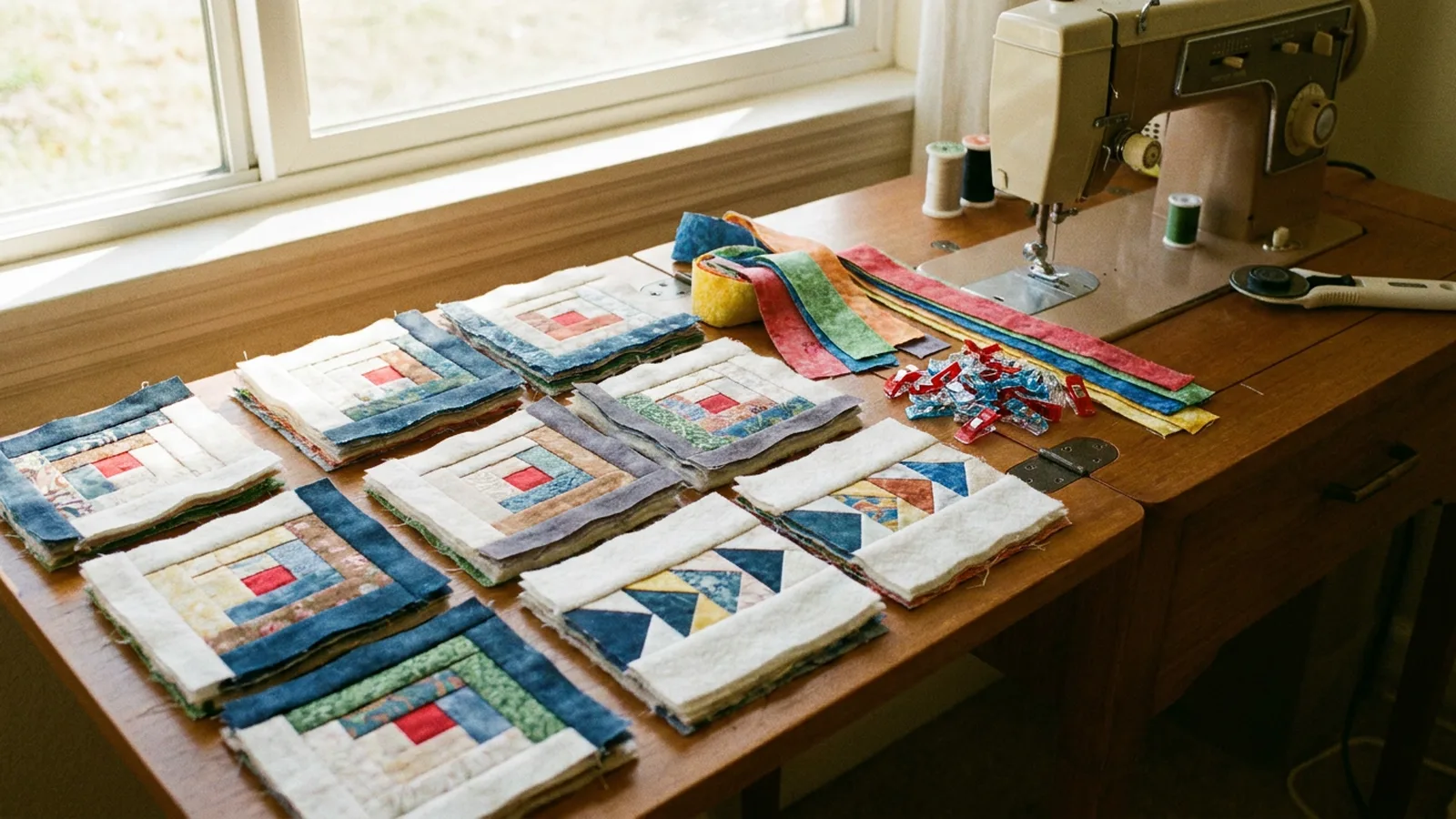
Quilt as you go means you quilt manageable sections before you join them. Piecing and quilting through the layers in one operation is one variant, not the required meaning of the term. Patchwork Posse sews scraps onto fleece fused to the backing, and the 12 block project stitches the top, batting, and backing in one step. Jan Piersons joins blocks that are already quilted. WeAllSew quilts collage blocks, then joins them. Join with a sashing strip when you want a band between blocks. Join with a folded backing when the blocks should meet. A foundation of fleece or batting is the way to build a small piece that is quilted as the scraps go down.
Four joins, and what each suits
| Join | What you sew | Suits |
|---|---|---|
| Foundation strips | Scraps onto fleece, then blocks right sides together with a strip over the back seam | A small scrap piece, or a project about the size of a place mat |
| Folded backing | A 1/4 inch seam through the tops, batting laid over the seam, backing topstitched | Log cabin blocks that should meet with no sashing band |
| Sashing strip | Quilted blocks stitched into a sashing strip through all three layers | A grid of blocks that wants a visible band between them |
| Back seam, front sashing | A tidy seam on the back, then sashing along the front seams | A collage quilt, in the captured tutorial on a longarm |
The table is the choice. The steps below are the captured versions of each join.
Foundation strips
Patchwork Posse builds the quilt on fusible fleece cut a little larger than the finished size. The sample project uses an 8 by 10 inch piece, trimmed later. Fuse the fleece to the wrong side of the backing, cut to the same size. If you have regular batting instead of fusible fleece, pin it or use a spray adhesive. Place a scrap right side up on the fleece. Place the next scrap right sides together, match one edge, sew, flip, and press. Keep adding scraps until the fleece is covered. Extra stitching lines are optional, for the look.
That tutorial's own reply on how to join the finished blocks: sew them right sides together, the way you would sew ordinary blocks. The back then shows raw edges. Cover those edges with strips of fabric, similar to a binding strip. They cover the seams and look like sashing. This join suits a small scrap top, a place mat, or any piece you would rather quilt as it grows than baste as one sandwich. A reader on that page uses a 1 inch strip as sashing between blocks. The tutorial itself describes the strip as a cover for the seam, like binding.
Folded backing
Jan Piersons joins already quilted log cabin blocks with the Georgia Bonesteel method, written as an edge-to-edge join. Put two blocks front sides together. On the top block, fold back the backing and the batting, and pin. On the bottom block, pin back only the backing. Sew a 1/4 inch seam with a walking foot, through the tops and the batting that stayed in the seam. Open the blocks so the backing faces you. Lay the batting that stayed out of the seam over the join. Smooth one backing side down, fold the other side over, and pin along the topstitch line. Leave an inch at each end so you can fold the backing back again when you join the rows. Topstitch between those marks with a stitch the same size as the quilting.
This join suits log cabin blocks, or any block set that should meet edge to edge. It needs a little extra batting and backing at the joins, because there is no sashing to hide a short cut. Mark the inch you left at the row ends so you still have fabric to fold when the rows go together.
Sashing strip
The 12 block project quilts each block while the top is pieced. Backing goes wrong side down on the batting. Pieces are placed by number and stitched with a scant 1/4 inch seam, then flipped and pressed. Trim each block to 14-1/2 inches square. Vertical joins use 15-1/2 inch Sash-In-A-Dash strips. Place the blocks into the strips, pin, and stitch through all three layers close to the outside edge of the strip. Horizontal strips in that project are cut at 47 inches for the row length they show.
This join suits a multi-block quilt that wants a sashing grid. The strip is both the join and the visible band. You need a strip long enough for the row, and a walking foot or a quilting foot that can stitch through the block, the strip, and the backing together. The binding guide is the last edge, after the rows are joined.
Back seam, then front sashing
WeAllSew demonstrates a collage version on a longarm: quilt the blocks, join them with a tidy seam on the back, then apply sashing along the seams on the front, and add a border after that. The captured page is the method list, written for a BERNINA Q 16. It suits a quilt where the back should look like a finished seam and the front should show a sashing line. A home-machine sewer can copy the order, seam then sashing, using the folded-backing seam or a right-sides-together seam from the other tutorials. The longarm setup in that post is a different machine.
One honest limit: these four pages were written for different machines and different block styles. A longarm collage join is a different setup from a home-machine walking-foot seam. Pick the join that matches the machine you have, and whether the design wants a band between blocks.
Free pattern names on the ranking list
The captured Quilt Therapy index is a list of free pattern names, not a join comparison. The names on that page are:
- Herringbone, Autumn Vibes Friendship Braid, and A Stitched Typography, from Maureen Cracknell
- String Quilt, from Pattern Poole
- Wrapped Up, from Pat Wodskow via All People Quilt
- Power of Nine, from Sherri Noel
- Quilt-As-You-Go Quilt, from Abby Holverson via Instructables
- Glowing Pineapple, from Sylvia Q. Davis
- Joining Quilted Log Cabin Blocks, from Janis P., which is the folded-backing tutorial above
- Simple Cathedral Windows and Frayed Seams, from Jera Brandvig
- A 2.5 inch hexagon quilt, from Dalton Gentry via Missouri Quilt Co.
- Quick Rail Fence, from Fiona Law
- Quilt as You Go Coins, from Teri Stillwell
- A quilt-as-you-go tutorial from Fiona at Bubz Rubz, and the Patchwork Posse tutorial above
- Cathedral Window Quilt As You Go, from Amy Gibson
- A quilt-along from Penny at Sew Take a Hike
- North West, Bear Mountain, Scottish Thistle, Scattered Geese, and Go Fly a Kite, from Cori at Hey Let's Make Stuff
Use that list to pick a block style. Use the join table to decide how the sections meet. A log cabin block is the one the folded-backing tutorial joins. A rail fence is on the same index as a quilt-as-you-go coins and rail project. Plan the backing size before you cut the foundation, using the backing guide.
Strip piecing a whole top, then quilting it as one sandwich, is a different order from quilt as you go. See lane strip quilt, $8.99, coming soon.
How does quilt as you go work?
You quilt manageable sections before you join them. Piecing and quilting through the layers in one operation is one variant, not the required meaning of the term.
How do I join quilt as you go sections?
Sew the sections right sides together, then either cover the raw back seam with a strip or fold the backing over the seam and topstitch it.
Do quilt as you go blocks need sashing?
Use a sashing strip when you want a band between blocks. Use the folded-backing join when the blocks should meet at a 1/4 inch seam.
Can I quilt as you go on a home sewing machine?
Yes. The foundation-strip method and the folded-backing join both use a home machine. One captured collage join is written for a longarm.