
Quilt backing fabric: width and yardage
Published 2026-10-15. Updated 2026-10-15.
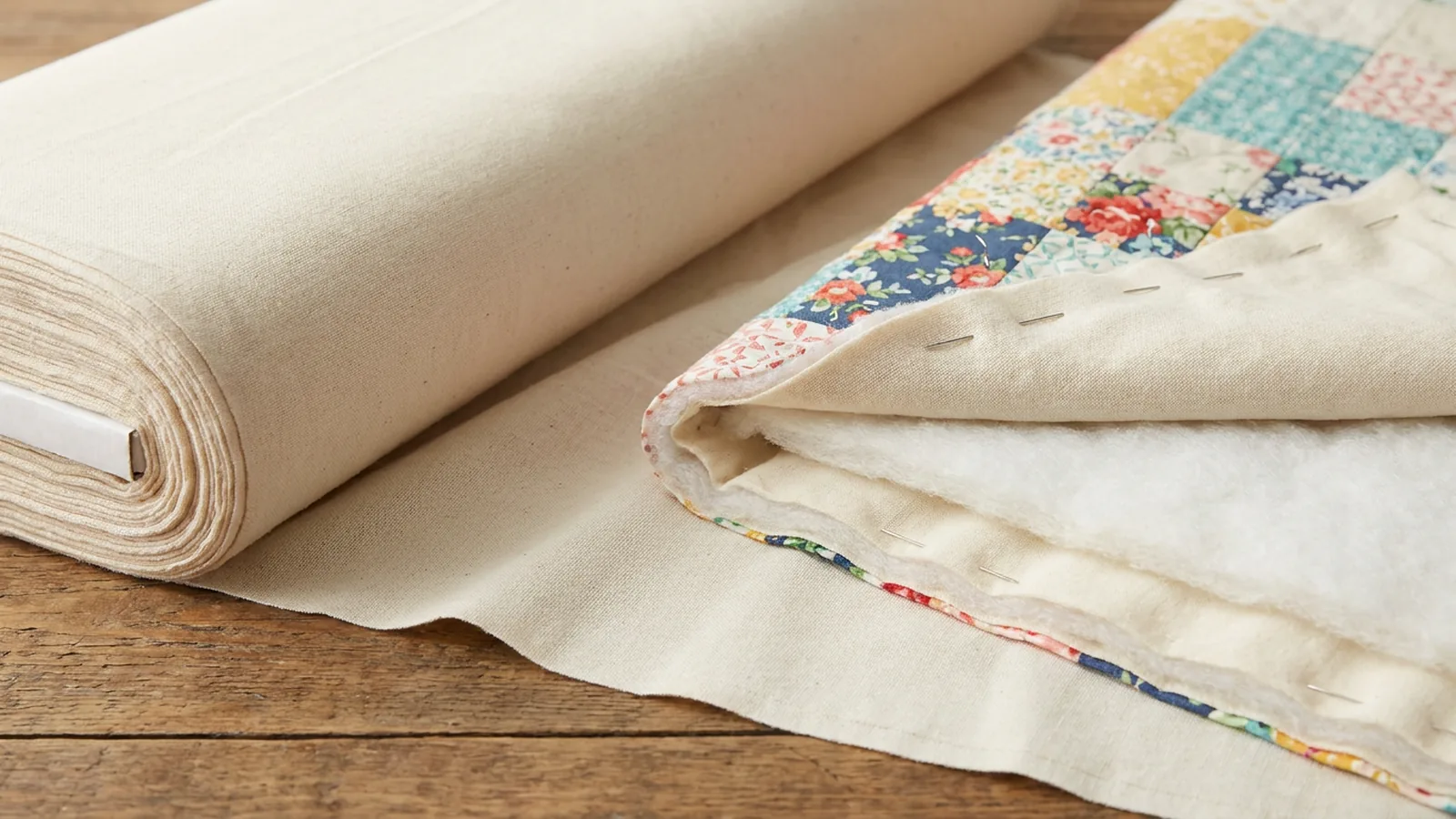
Use quilting-weight cotton, and make the back at least 4 inches larger on every side than the quilt top. A finished quilt of 60 by 70 inches then needs a back of 68 by 78 inches. That is 4 yards of 42-inch cotton with a horizontal seam, 4 1/2 yards with a vertical seam, or 2 1/4 yards of 108-inch wide fabric with the seam left out. Standard cotton is 40 to 42 inches wide after the selvages are trimmed. Extra-wide backing is sold at 108 inches, and some bolts run 106 to 108 or 116 to 120 inches.
What to put on the back
The Quilt Show describes backing as the bottom layer of the quilt sandwich. It is usually cotton, and it can also be flannel, lawn, or fleece. A plain back shows the quilting. A light quilt top wants a light back, because a dark back can shadow through. The same page treats sheets and decorator fabric as a poor choice, because a high thread count makes them hard to quilt.
Hailey Stitches takes the other view on sheets: a 100 percent cotton sheet can be an affordable back if it is the right size, and a flannel sheet should be washed first because flannel shrinks more than quilting cotton. Both pages are in the captured set. If you quilt by hand or send the top to a longarm quilter, follow the Quilt Show caution and use quilting cotton. If you are machine quilting at home and the sheet is 100 percent cotton, Hailey's option is the one she publishes.
Quilting Mayhem adds the specialty backs. Cotton lawn and rayon drape for a summer quilt. Knits are soft and stretch, so they pucker if you pull them while you quilt. Cuddle and minky are plush for baby and lap quilts and are often pieced because they are usually narrower than 108 inches. Flannel should be prewashed. Wide cotton backs skip the seam, reduce bulk, and often cost less per yard than several lengths of 40-inch cotton.
Pieced cotton versus a wide back
Hailey's piecing order is short. Cut off the selvages. Cut the length into two or three panels. Sew with right sides together and a 1/2 inch seam, then press the seam open. A yard is 36 inches long. She plans on a 42 inch width. Two widths with that 1/2 inch seam give 83 inches, because 42 plus 42 minus 1 is 83.
Quilting Mayhem's usable width is 40 to 42 inches after the selvages. If your bolt is 40 inches, Hailey's 42 inch plan is a little generous. Measure the fabric after you trim the selvages, then rerun the panel count.
Add 4 inches on each side, which is 8 inches on the width and 8 inches on the length. That is the same 4 inch rule Mayhem states for longarm quilting or basting. A longarm quilter may ask for more. Ask before you cut if someone else will quilt it.
| Quilt size, inches | Backing size, inches | Pieced 42-inch cotton | 108-inch wide back |
|---|---|---|---|
| Baby 30 x 40 | 38 x 48 | 1 1/2 yards, one panel | 1 1/2 yards |
| Throw 50 x 65 | 58 x 73 | 3 1/4 yards, horizontal seam | 1 3/4 yards |
| Example 60 x 70 | 68 x 78 | 4 yards horizontal, or 4 1/2 yards vertical | 2 1/4 yards |
| Twin 70 x 90 | 78 x 98 | 5 1/2 yards, vertical seam | 2 3/4 yards |
| Full 85 x 108 | 93 x 116 | 7 3/4 yards, three panels | 3 1/4 yards |
| Queen 90 x 108 | 98 x 116 | 8 1/4 yards, three panels | 3 1/4 yards |
| King 110 x 108 | 117 x 116 | 9 3/4 yards, three panels | 108-inch cloth is short |
The pieced yardage is Hailey's published count, rounded up to the next 1/4 yard. The 108-inch column is the same backing length divided by 36, also rounded up to the next 1/4 yard, and only when the other side fits on a 108-inch bolt.
A throw back is 58 by 73 inches. 73 divided by 36 is a little over 2, and the shorter side is 58, so the bolt length to buy is 58 inches. 58 divided by 36 is 1.61, which rounds up to 1 3/4 yards. A twin back is 78 by 98. 98 divided by 36 is 2.72, which rounds up to 2 3/4 yards, and 78 fits on 108. Full and queen backs are 116 inches on the long side. 116 divided by 36 is 3.22, which rounds up to 3 1/4 yards. The full width of 93 and the queen width of 98 both fit on 108.
Hailey's king goal, after 4 inches on every side of a 110 by 108 inch quilt, is 118 by 116 inches. Her published 9 3/4 yard cut is three 3 1/4 yard panels. Sewn together, that piece measures 117 by 124 inches, and she trims it to 117 by 116 inches. The side extra is then 3 1/2 inches on the 110 inch width, which is short of the 4 inch rule. A 108-inch bolt is narrower than both 117 and 116, so turning the cloth still leaves one side uncovered. A bolt in the 116 to 120 inch group covers the shorter side when the cloth measures at least 116 inches. Cut the longer side along the bolt. A 116 inch bolt covers a 118 inch king back used that way. It is short of 118 only when 118 is the width across the bolt.
Copy the 60 by 70 example when the finished top is a size the table leaves out. Add 8 inches to each dimension. If the shorter side is at most 108, buy the longer side divided by 36, rounded up to the next 1/4 yard. If you are piecing 42-inch cotton, two panels cover a width up to 83 inches. Three panels cover a wider quilt. Compare a horizontal seam and a vertical seam. On the 60 by 70 example the horizontal seam uses 4 yards and the vertical seam uses 4 1/2 yards.
Where the wide cloth is sold
The three pages that rank first for this search are shops, not yardage lessons. Your Quilt Shop sells cotton and flannel backs at least 108 inches wide, by the listing. Cary Quilting sells a wide backing collection. Backside Fabrics sorts bolts into 106 to 108 inches and 116 to 120 inches. Hailey names Fat Quarter Shop as a place she buys 108 inch backs. The bed-by-bed yardage is in the table above. Buy the length from a shop that has the width you measured.
Finished size comes first. The size chart pairs mattresses with quilt sizes so you know which row you are backing. After the quilt is quilted and trimmed, the binding guide counts the strips for the edge.
The limit is the bolt in your hand. A plan built on 42 inches fails if the cloth is 40 after the selvage is cut off, and a 108 inch label fails if the king back is 118 inches wide. Measure the top, add 8 inches each way, then measure the fabric.
See the full quilt queue bundle, coming soon at $15.00.
What's a good backing for a quilt?
Quilting-weight cotton is the usual back. Extra-wide cotton, about 108 inches, skips the seam on many bed sizes. Flannel is a warm option if you prewash it.
How wide is extra wide quilt backing?
Shops list extra-wide backs at 108 inches, and one shop also groups 106 to 108 inch and 116 to 120 inch bolts.
Where can I buy wideback fabric?
Your Quilt Shop, Cary Quilting, and Backside Fabrics all sell wide quilt backs. Hailey Stitches also names Fat Quarter Shop for 108 inch backs.
Where can I find wide fabric by the yard?
Your Quilt Shop, Cary Quilting, and Backside Fabrics list wide backing collections. The saved pages name widths. A selling increment is not printed on those pages. Measure the bolt. A listed range of 116 to 120 inches is a group, so measure the cloth on the bolt.