
Log Cabin Quilt Pattern: Rounds, Pressing, and Courthouse Steps
Published 2026-10-15. Updated 2026-10-15.
A log cabin is pieced from the center outward, one strip at a time, in a single direction. Freshly Pieced cuts every strip 2.5 inches wide and sews them in this order: two 2.5-inch squares, then strips 4.5, 4.5, 6.5, 6.5, 8.5, 8.5, 10.5, 10.5, 12.5, 12.5, and 14.5 inches long. That page labels the block 12.5 inches unfinished and 12 inches finished. At a quarter-inch seam the last strip is 14.5 inches and is sewn across the full final side, so the block is 14.5 inches unfinished and 14 inches finished. The 12-inch finished block on this page is the courthouse steps chart below.
Press each seam before you add the next strip. Freshly Pieced presses seams open, or toward the outer edge, and keeps that choice for the whole block. Courthouse steps uses a different order: sew each pair of strips to opposite sides, then turn to the other pair of sides. Adventures of a DIY Mom builds a 12-inch courthouse steps block that way, and Freshly Pieced names that opposite-side order so it is not confused with the circular log cabin.
The charts below assume a quarter-inch seam. A wider seam makes the last strips too long for the growing block, so check the block against the chart after each round and trim only if a strip was cut long.
Strip lengths for the circular log cabin
Freshly Pieced labels this block 12.5 inches unfinished and 12 inches finished. All strips are 2.5 inches wide. The two short pieces are squares. Every later piece is a strip whose length is the side it covers.
| Piece in sewing order | Cut length |
|---|---|
| Center square and first log | 2.5 inches |
| Next two logs | 4.5 inches |
| End of round one, start of round two | 6.5 inches |
| Next two logs | 8.5 inches |
| End of round two, start of round three | 10.5 inches |
| Next two logs | 12.5 inches |
| Last log | 14.5 inches |
Sew right sides together, a quarter inch from the edge, and stay in one direction. Freshly Pieced goes counter-clockwise in the sample and says clockwise works if you keep that direction for the whole block. The shortest pieces stay on the starting side, which is how you find your place after a break.
Those lengths are the sides the strips cover. With a quarter-inch seam, the first round ends at 6.5 inches square unfinished, the second round ends at 10.5 inches square, and the third round ends at 14.5 inches square. Joined into a quilt, that block finishes at 14 inches, a half inch less than the unfinished square. Generations Quilt Patterns states that the finished size is a half inch less than the unfinished measurement, to account for the seam allowance. The 12.5-inch label on this list is the page's words. The courthouse steps chart below is the cut list that finishes at 12 inches.
A quarter log cabin is a different shape: logs on only two sides of the hearth. Stitched in Color also shows logs on three sides of a door-shaped center. Those are design choices, not the circular chart above.
Press open, or press toward the outside
Press after every strip, not at the end of the block. Freshly Pieced likes an open seam because the logs need not nest, and also accepts a side press if it always goes toward the outer edge.
Courthouse steps has the same two choices, written out by Generations Quilt Patterns. Press every seam allowance away from the center square, and grade a dark seam if it shadows through a light log. Or press every seam open so the dark fabric sits under itself. Generations presses the 11-inch sample open to reduce bulk, and presses the first small pair one strip at a time so the seam stays flat.
Adventures of a DIY Mom is more specific for the opposite-side block: press the seams outward after each pair is sewn. Pick one of these orders and use it on every block in the quilt. Mixed pressing makes the corners sit at different heights when you join the blocks.
Courthouse steps, sewn as opposite pairs
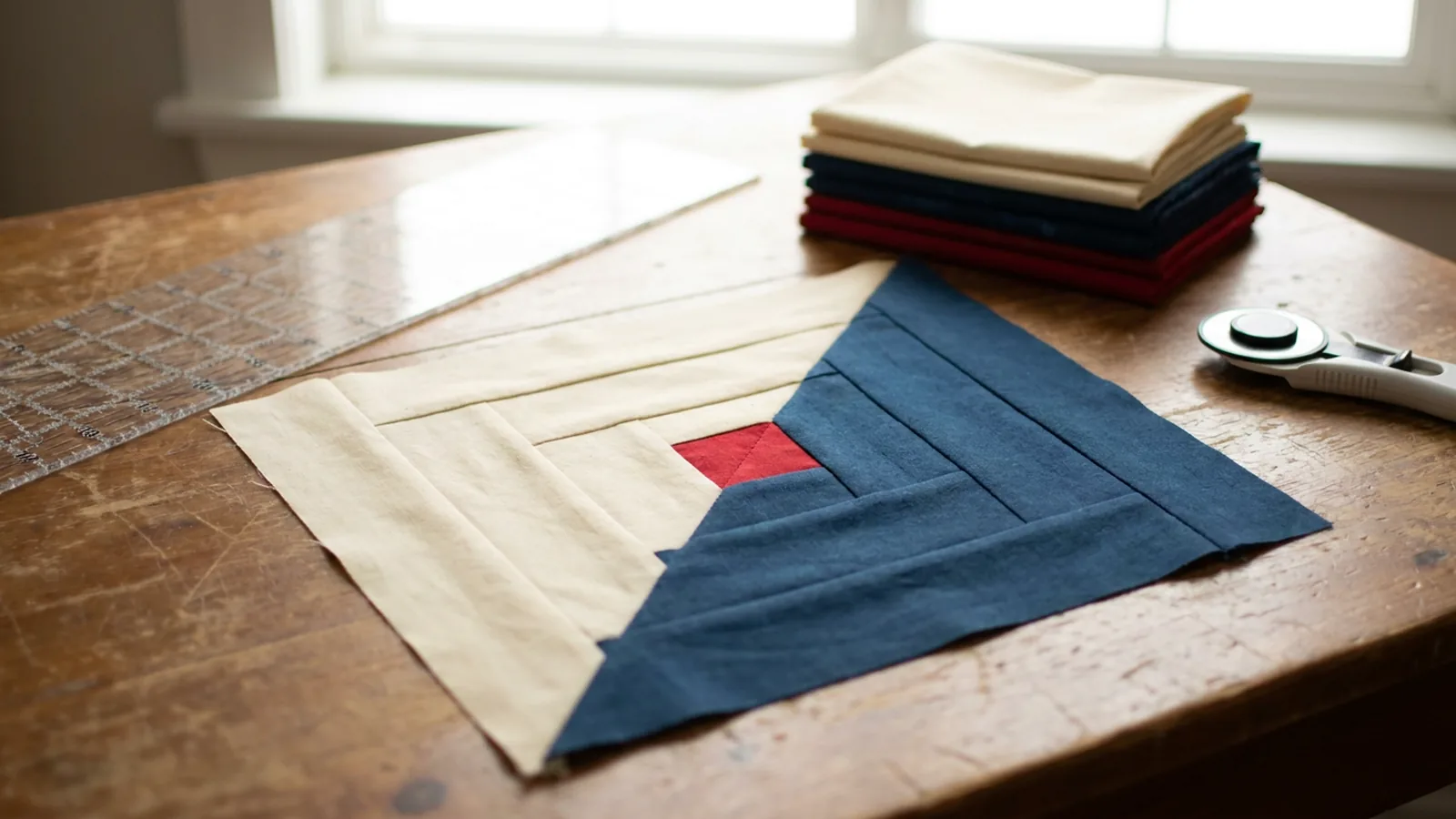
Courthouse steps begins with a square center, the "door," and adds strips in pairs. Adventures of a DIY Mom sews a light pair to two opposite sides, presses outward, then sews the next pair to the remaining sides. The pairs alternate light and dark as the block grows.
For that published 12-inch block, cut these pieces. Width is listed first.
| Piece | Fabric | Cut |
|---|---|---|
| Center, one piece | Dark | 3 1/2 by 3 1/2 inches |
| First pair | Light | 2 by 3 1/2 inches |
| Second pair | Dark | 2 by 6 1/2 inches |
| Third pair | Light | 2 by 6 1/2 inches |
| Fourth pair | Dark | 2 by 9 1/2 inches |
| Fifth pair | Light | 2 by 9 1/2 inches |
| Last pair | Dark | 2 by 12 1/2 inches |
The page also offers a 6-inch version in the printable. Use a quarter-inch seam, and check that each new pair matches the long side of the unit you just pressed.
Generations Quilt Patterns publishes the same opposite-side construction in four finished sizes, including 11 and 22 inches. The unfinished sizes on that chart are 6, 11 1/2, 17, and 22 1/2 inches. The finished size is a half inch less than the unfinished measurement, which is the seam allowance that disappears when the block is joined. The 22-inch size uses 2 1/2-inch strips, so a jelly roll can feed that one size. You can stop after fewer rounds. The chart is a ladder, not a requirement to sew every round.
How block count scales to a bed
Divide each side of the quilt by the finished block size. Use finished inches, not the raw block, because the seam between blocks is already in that finished number. Suzy Quilts lists a crib or toddler quilt at 36 by 52 inches and a throw or lap at 50 by 65 inches, and says those figures are approximate and can vary by 4 to 8 inches. Measure the bed if you have it. A longer chart, including twin, full, queen, and king, is on the quilt size chart.
A block that finishes at 12 inches, the courthouse steps chart above, tiles that crib in threes across the 36-inch width. Four of those blocks cover 48 inches of the 52-inch length, so the leftover length is a border, not another full block. The circular strip list finishes at 14 inches, a different grid from that three-across crib. A 12-inch grid leaves a remainder on both sides of the 50 by 65 inch throw. Change the block size, add a border, or add sashing rather than forcing a partial log into the gap.
One real quilt shows the same idea at scrap size. Lo & Behold Stitchery sewed 100 log cabin blocks into a top that measured about 80 by 80 inches, then trimmed it to about 64 by 64 inches. That is one maker's measurement, not a standard bed.
Fabrics, colors, and yardage
Two values are enough for the classic block. Stitched in Color describes the uniform-log cabin as half dark and half light. Love Patchwork & Quilting records the old hearth custom: a red center, then strips in a clockwise or anti-clockwise direction, dark on one side and light on the other. The red center is a tradition you can skip. Freshly Pieced uses warm colors on one side and cool colors on the other, or one color per round, or a random mix.
A scrappy block can use many more fabrics. Lo & Behold tried three fabrics in each block, then split the block into color groups so small scraps could mix inside each half. Their strips are 1.5 inches wide, the smallest piece is 1.5 by 2.5 inches, and the largest is 1.5 by 8.5 inches, with 2.5-inch squares for the centers.
Yardage depends on strip width and how many fabrics share a block. Freshly Pieced cuts the circular strip list from a quarter yard in total, fat quarter or straight quarter. Suzy Quilts says one jelly roll, about 40 strips, makes a baby log cabin, and one and a half jelly rolls make a throw. Add solid yardage if you want the prints to read as logs rather than as a jumble. Those figures are plans for those strip widths, not a yardage for every log cabin.
The hearth cabin quilt is coming soon at $8.99.
Design your own cabin
Keep the center-out order and change one thing at a time.
- Strip width. Suzy Quilts says the logs can be any width. On 2 1/2-inch strips, each new pair is 2 inches longer than the pair before it, which is how a quarter-inch seam on both ends is already in the cut length.
- Number of rounds. Love Patchwork & Quilting says the number of logs is your choice. Stop when the block is the size you want, then square it.
- Which sides get logs. Circular order is the log cabin. Opposite pairs are courthouse steps. Two sides are a quarter log cabin. Three sides make the door-shaped block in the Stitched in Color set.
- Value. Light against dark makes the diagonal read from across the room. Equal values make a texture block instead of a path.
- Construction method. The same logs can be template-pieced or foundation paper pieced. Love Patchwork & Quilting names both. A paper-piecing start is on the foundation paper piecing guide. Straight-seam squares, the skill under the log cabin, are on the four patch quilt pattern page.
Block settings are the "quilt patterns" people mean when they ask how to quilt a log cabin. Turning the dark half the same way in every block makes a field of diagonals. Turning blocks so the darks frame a light square is a different setting of the same block. Stitched in Color's throw uses that framed, on-point idea. Machine-quilting motifs are a separate choice. The free-motion quilting designs guide covers stitch motifs. The pages above are piecing lessons, not pantograph catalogs.
Free log cabin lessons
These captured tutorials are free to read:
- Freshly Pieced, Quilting 101: the circular strip list, which finishes at 14 inches, and the circular order.
- Lo & Behold Stitchery: a scrap block with 1.5-inch strips and a 100-block quilt measurement.
- Adventures of a DIY Mom: opposite-side pairs for a 12-inch courthouse steps block.
- Generations Quilt Patterns: a four-size courthouse steps cutting chart and a pressing choice.
- Suzy Quilts: a jelly-roll log cabin and a note that strip width is your choice.
- Stitched in Color: quarter, three-sided, and half-dark layouts.
For the wider set of blocks this one sits in, see quilt block patterns.
How to make log cabin quilts?
Start at a center square and add strips in one direction around it. Press each seam before the next strip. The 12-inch finished block on this page is the courthouse steps cut list, not the 2.5-inch circular strip list.
What is the traditional layout of a log cabin quilt?
The classic block splits value: one half of the logs is dark and the other half is light, with strips added clockwise or counter-clockwise around a center hearth.
How many fabrics do you need for a log cabin quilt?
Two values, one light and one dark, are enough for the classic split. A red center is a hearth tradition, not a rule, and a scrappy block can use many more fabrics.
What are the typical measurements for a log cabin quilt block?
Freshly Pieced labels a 2.5-inch-strip block 12.5 inches unfinished and 12 inches finished. Those cuts finish at 14.5 inches unfinished and 14 inches finished. Courthouse steps charts publish a 12-inch finished block, an 11-inch sample, and a 22-inch size.
How much yardage for a log cabin quilt?
The circular strip list is cut from a quarter yard in total. One jelly roll of about 40 strips is enough for a baby quilt in one published plan; a throw in that plan uses one and a half jelly rolls.
- Freshly Pieced: Quilting 101: Make a log cabin block
- Lo & Behold Stitchery: My Scrappy Log Cabin quilt
- Adventures of a DIY Mom: Courthouse Steps Quilt Block Tutorial
- Generations Quilt Patterns: Courthouse Steps Quilt Block
- Stitched in Color: my 8 favorite Patchwork Log Cabin blocks
- Suzy Quilts: The Ultimate Guide To Quilt Sizes
- Suzy Quilts: Make Your Own Log Cabin Quilt Pattern
- Love Patchwork & Quilting: Inspiring quilt blocks for quilters of all abilities