
Rail fence quilt pattern: block size, layouts, and a free start
Published 2026-10-15. Updated 2026-10-15.
A three-rail fence block made from 2 1/2 inch strips finishes at 6 inches. Cut the square at 6 1/2 inches. Suzy Quilts states the relationship in one line: three strips of 2 1/2 by 6 1/2 inches make a square, because you subtract the seam allowance and 2 times 3 equals 6, which matches the cut length. The seam she is subtracting is the 1/4 inch seam she uses on every rail.
That is the block size. The quilt size is how many of those squares you turn and join. A free page below lists a one-roll layout with an open strip count. A jelly roll, on Suzy's page, is a bundle of 2 1/2 by 42 inch strips.
Sew the set, then turn the squares
Divide the strips into sets of three. Patchwork Posse sews the long edges, presses, squares one end, and cuts 6 1/2 inch squares. That page gets 6 squares from each strip set, and it keeps a ¼ inch seam. It lists 40 strips, 2 1/2 inches by the width of fabric, for the top. Those 40 strips make 13 complete three-strip sets and leave one strip over. At 6 blocks a set, that is 78 blocks. The same page lays out 9 rows of 9, which is 81 blocks. The two counts leave 3 blocks unaccounted for. Sew the 6 1/2 inch square and the turn. Treat the 40-strip list as an open count, not a closed fabric total.
Lay the squares so the rails alternate. One square has the rails running up and down. The next has them running across. That turn is the fence. If you sew every square the same way, you have a strip quilt, not a rail fence.
Press toward the darker rail when you can. The seams in a turned layout do not all nest the same way, so pin the joins where a rail meets a rail.
If you are not using a jelly roll, Suzy's reply to a reader is 24 strips of 2 1/2 by 39 inches for the look she was discussing. Shorter scraps can be cut 2 1/2 by 6 1/2 inches and chain-pieced one block at a time. The finished square is the same only when you still have three rails.
Layouts the block makes
Generations Quilt Patterns draws two basic layouts from a three-strip block, light to dark, so the dark rail shows the design.
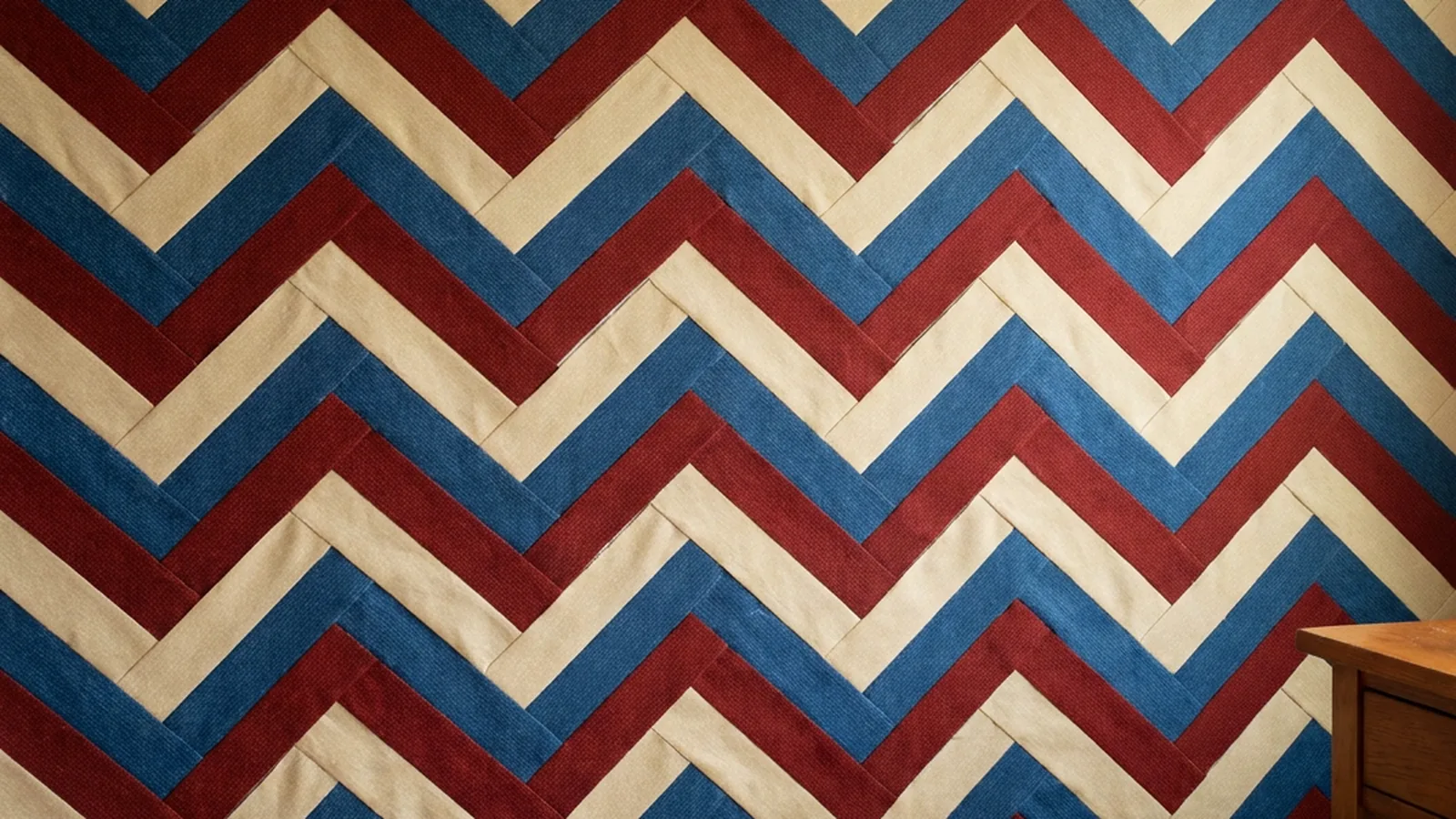
The zigzag: odd rows start with the dark rail on the left. Even rows start with the dark rail on the top. The dark rails step across the quilt. Set the same blocks on point and those diagonal rows run up and down instead of across.
The pinwheel: odd rows alternate a dark rail on the left, then on the bottom. Even rows start with the dark rail on the top, then on the right. Four blocks meet as a small pinwheel. Sashing is uncommon on this block. Generations notes that a few modern quilts add it, and that a 5-strip block, graded light to dark, reads as a woven zigzag when the blocks are set on point.
Patchwork Posse's sewn example is the simple alternate: vertical square, horizontal square, 9 rows of 9 squares, finishing at 54 inches square. That page also names diagonal stripes and chevrons as turns of the same squares. Nine finished 6 inch blocks are 54 inches, so the block size and the stated quilt size agree. That agreement is the block math. It is not a check that 40 strips fill the 9 by 9. A larger top is more blocks of the same cut, not a different block. Suzy's note on a queen, which she calls typically 90 by 108 inches, is that 2 jelly rolls can make that size if you add a slightly wider border. That is a reader reply on her page, not a full cutting chart.
The rank-2 result, Jordan Fabrics, is titled layouts and borders. The page text has no strip width and no named layout. The pictures, if they load in a browser, are not a cutting plan.
Value is what makes the turn visible. Generations Quilt Patterns places the dark rail where the eye should travel, light to dark, so the zigzag and the pinwheel read at a distance. If every strip is the same value, the turn still makes a block, and the fence disappears into a plaid. Suzy Quilts names light, medium, and dark as the three values that cover most variations. A scrap block can skip that plan: cut every scrap 2 1/2 by 6 1/2 inches, sew three at a time, and let the rails mix. The square still depends on three rails and that cut. Two rails, or four, will not land on the 6 inch finish she states.
Straight-line quilting, the pass Patchwork Posse uses on the 54 inch top, can follow the dark rail. A second pass on the diagonal crosses the turned blocks. Neither page sets a stitch length, so use the length you already trust for a 1/4 inch seam.
Free pages, and what they skip
Yes, there is a free pattern page. Patchwork Posse writes 40 strips, 6 1/2 inch squares, 9 by 9, and 54 inches, plus straight-line quilting and binding from 2 1/2 inch strips. Keep the square size and the quilting note. The strip count leaves the 3-block shortfall counted above. Generations Quilt Patterns writes the layouts and offers free coloring pages. The strip-width figure on this page is the one Suzy Quilts states. Material Girl Quilts links a free printable for a one-jelly-roll version of a quilt that had used two rolls in an earlier post. The printable file is not in this capture, so the cutting numbers above come from Suzy Quilts and Patchwork Posse, not from that link.
Fence rail and rail fence are the same block. Search either name and use the three-rail cut.
To quilt it, follow the rails with straight lines, which is what Patchwork Posse uses on the 54 inch top. A diagonal line across the zigzag is the other common pass, because the turned blocks already give you both directions. Neither page specifies a stitch length.
Not this fence
A rail fence is a turned block. A plain strip quilt is not. If you want strips sewn in order and left as strips, that is a different design.
See the lane strip quilt, coming soon at $8.99.
Next, compare other strip starts in the jelly roll quilt guide, or the jelly roll race if you would rather not cut the strips into squares. Bed sizes for the border decision are in the quilt size chart.
How do you make a rail fence quilt?
Sew three strips into a set, cut the set into squares, and turn every other square so the rails run the other way. A 2 1/2 inch strip finishes at 2 inches, so three rails finish at 6 inches. Cut the square at 6 1/2 inches.
How to quilt a rail fence pattern?
Straight-line quilting follows the rails. Patchwork Posse uses that approach on the 54 inch square it describes. Diagonal lines across the zigzag also work, because the seams already run in both directions.
Is there a pattern for a rail fence quilt?
Yes. The block is three strips sewn and recut into squares. Written cutting numbers are on the free pages named below. A fence-rail quilt is the same block; the name is only reversed.
Is there a free pattern for a Rail Fence quilt?
Yes. Patchwork Posse publishes a free page listing 40 strips and a 54 inch square in a 9 by 9 layout, and those figures leave 3 blocks unaccounted for. Generations Quilt Patterns publishes free coloring pages and the two basic layouts. Material Girl Quilts links a free printable for a one-roll version.
Is there a pattern for a fence rail quilt?
Yes. Fence rail and rail fence name the same strip block. Use the three-rail cut above and turn the blocks so the rails alternate. The free 54 inch page is a layout reference with the same open strip count.
- Suzy Quilts: Everything You Need To Know About The Rail Fence Quilt Pattern
- Patchwork Posse: Free Rail Fence Quilt Pattern - Jelly Roll Quilt
- Generations Quilt Patterns: Rail Fence Quilt Pattern Designs
- Jordan Fabrics: Rail Fence Layouts and Borders
- Material Girl Quilts: Jelly Roll Rail Fence, a free quilt pattern