
Mini quilt patterns: one block, a border, and a way to hang it
Published 2026-10-15. Updated 2026-10-15.
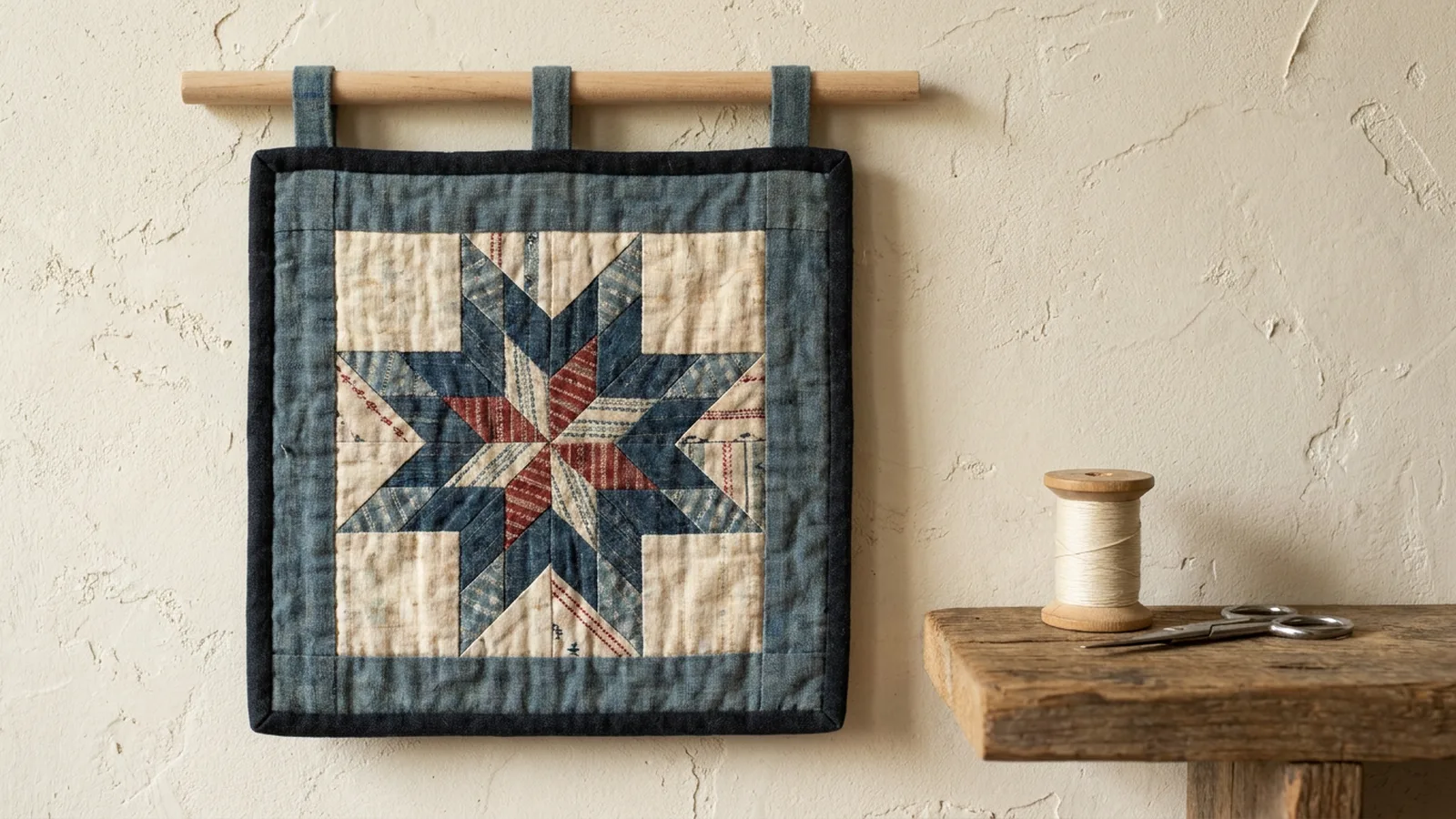
Finish one block as a mini quilt: layer it, quilt it, and bind it. A captured friendship-star mini finishes at about 8 inches square. A captured sampler wall hanging finishes at 37 ½ inches square. Add a border only when you want a frame around the block. Hang a small quilt with a sleeve or with pockets and a dowel, or mat a very small piece.
One block becomes the quilt
The friendship mini is one block: 16 half-square triangles and 9 squares. It is written as a first quilt. Cut 2 ½ inch squares for the triangles, trim the triangles to 2 inches, and sew them with 2 inch plain squares. Layer the pieced block on a 9 inch square of batting and a 9 inch square of backing. Quilt with a walking foot. The tutorial follows the angles of the star with lines 1/4 inch apart. Bind with a 2 ½ inch by 40 inch strip. That is the whole path from one block to a finished mini: piece, layer, quilt, bind.
A Quilting Life says any small blocks in combination, or one medium to large block, can be a mini quilt, then hung like art. If you already have a block, you do not need a second pattern. Square it, add a border only if the wall wants a frame, and finish the edge.
Choose the block on the block guide. A star block uses the same half-square triangles as the friendship mini. The steps for those units are on the half-square triangle guide. A plain cross is a different block from the friendship star. Our plain cross block: $4.00, coming soon.
Borders, or binding alone
The friendship mini has a binding edge. The block is the quilt. Mini tips prefer a 2 inch binding width for most minis, and call a 2 ½ inch binding wide for most minis. The friendship tutorial still uses a 2 ½ inch strip, so both widths are in captured projects. Use the narrower strip when the mini is small and the binding starts to look heavy. Press seams open on tiny pieces so the binding and the quilting stay flat.
A larger hanging can take a frame. The Liberty sampler wall hanging finishes at 37 ½ inches square and lists sashing plus an outer border. That is the border choice when the hanging is a sampler: sashing between the blocks, then an outer border, then binding. The quilt version of the same pattern finishes at 56 ½ by 66 inches, so the wall hanging is the smaller cut, with its own sashing and border amounts.
One honest limit: these pages give project sizes, not one required wall-hanging size. Measure the wall, then pick the block count that fits. An 8 inch mini fills a small spot. A 37 ½ inch square is a sampler. A crib quilt at about 39 by 54 inches is a bed size, larger than either hanging. The size chart is the place for bed sizes.
Batting
A quilted hanging uses batting. The friendship mini cuts a 9 inch square of batting under an 8 inch finish. Four batting types sort the choice by loft. Low loft cotton, such as Warm & Natural, is the common quilt batting: enough loft to show the quilting, and flat enough to feed evenly. Quilter's flannel is called ideal for table runners and art quilts where flatness is desirable. A wall hanging is closer to an art quilt than to a bed quilt, so those two are the captured options. Hi-loft polyester is for extra puffiness, and it is harder to feed. Soft and Stable is listed for bags, not for a hanging.
On low-loft cotton, that batting guide suggests a quilting 90 needle and a stitch length of 3 mm, with a walking foot once the project is large enough that a dual feed struggles. The friendship mini is small enough for a walking foot from the start.
A block can go in a mat on its own. The matting tutorial uses a 5 by 7 inch mat and quilted art about 3.5 by 5 inches, with a little room inside the opening. The writer prefers a quilted piece for depth, and also lists matting a leftover block or a practice scrap. That is the path when the block is too small to hang from a dowel.
For a bed quilt, Honeybegood says to add about 6 inches to the width and to the length for the minimum batting size, and to add more if a longarm quilter asks for it. A mini does not use that bed allowance. Cut the batting a little larger than the top, as the friendship tutorial does with a 9 inch square, and trim after quilting.
How to hang it
Three captured methods cover the wall.
A show sleeve is a 4 inch fabric sleeve on the top back. Suzy Quilts cuts a strip 8 ½ inches wide by the quilt width minus 2 inches. The worked example is a 56 inch quilt: the strip is trimmed to 8 ½ by 54 inches. Hem each short end by 1/4 inch, then 1/4 inch again. Fold and seam the strip so the sleeve has slack for a rod. Place it about an inch from the top and from the sides, seam side down, and stitch to the back only. Stitches that go through to the front show on the quilt.
Small quilts can use a simpler hanger. The hang-small-quilts page uses a nearly full-width sleeve on a larger quilt, and a simpler method that uses less fabric on a mini. The mini tips make hanging pockets before the binding goes on, so the binding covers the raw edges. Slip a dowel through the pockets and rest it on small nails or 3M Command Hooks. That keeps the holes out of the quilt. A center tab or a corner triangle is the same idea, mentioned by readers on the hang page: a bit of fabric at the top or in the corners, caught in the binding, for a dowel or a hook.
After the hanging is planned, bind the edge. The binding guide covers joining the strip ends. If you want to practice free-motion stitches on something small before a bed quilt, the free-motion guide is the motif order, and a mini is a short place to try one of them.
What to do with a quilt block?
Finish it as a mini quilt: layer it, quilt it, and bind it. You can also mat a small block, or hang a larger one from a sleeve or from pockets and a dowel.
What are some good beginner wall hanging quilt patterns?
A friendship-star mini of half-square triangles and squares is written as a first quilt and finishes at about 8 inches square. One larger block, or a few small blocks, can be the whole hanging.
What size should a quilt wall hanging be?
Captured projects span about 8 inches square for a one-block mini and 37 ½ inches square for a sampler wall hanging. A crib quilt at about 39 by 54 inches is a bed size, larger than those hangings.
What is a good size for a quilted wall hanging?
Use the wall, not a bed chart. An 8 inch mini sits in a small spot. A 37 ½ inch square hanging is a sampler size from a captured pattern.
Does a quilted wall hanging need batting?
The friendship mini uses a 9 inch square of batting. A block can go in a mat on its own. A quilted hanging usually includes a batting layer.
What are some ways to hang quilts on walls?
Sew a sleeve for a show, or hanging pockets and a dowel on nails or Command Hooks for a small quilt. A very small piece can sit in a mat.
- SewCanShe: Monthly Mini Quilts for January, the Friendship Mini
- A Quilting Life: Mini Quilt Ideas and Trunk Show
- A Quilting Life: Best Tips for Mini Quilts
- A Quilting Life: How to Hang Small Quilts
- A Quilting Life: Liberty Sampler Quilt + Wall Hanging
- Suzy Quilts: How to Hang a Quilt
- WeAllSew: 4 Quilt Battings to Match Your Projects
- WeAllSew: Matting Quilts as Art
- Honeybegood: Common Quilt and Batting Sizes