
Two-Color Quilt Patterns: Contrast, Layouts, and a Blue-and-White Throw
Published 2026-10-15. Updated 2026-10-15.
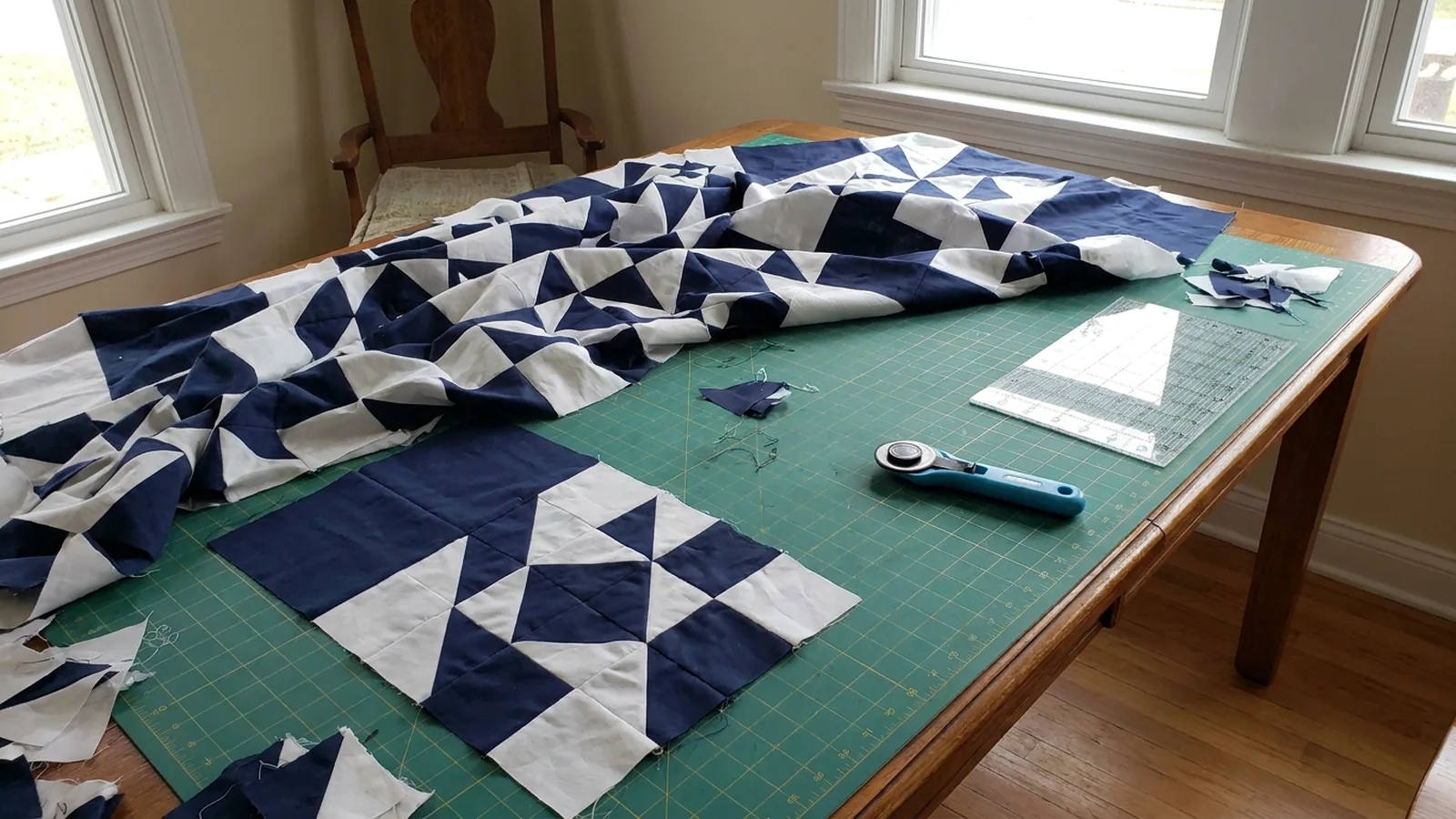
A two-color quilt needs contrast you can see from about 8 feet, then a layout that uses only those two fabrics. The classic pair is a color and white, in Judith Thomas's two-color class handout. For a blue-and-white version of that handout's borderless throw, use 3 yards of blue and 3 yards of white for a top of 51 by 75 inches, plus 1 more yard for binding. Beginner layouts that stay in two fabrics include a glorified nine patch, a straight-pieced black-and-white top, and an Irish chain, named on the Quilting Daily two-color page.
Contrast before the layout
Thomas's handout is blunt about why two-color quilts fail: the pieces are small, so a busy print hides the design. Stack the bolts and stand back about 8 feet. Keep the pair if you can see a difference. The dark print does not have to look very dark. It has to contrast with the light one. Tone-on-tones or quiet prints are the handout's recommendation. Large-scale prints are the ones to leave on the shelf.
The classic combination on that page is a color and white. A light and a dark of the same color can work. Two colors of the same value, the handout's example is black and red, can work only if the stand-back test still shows a difference. Blue and white is the color-and-white case: blue is the color, white is the light. If the blue is a pale sky print and the white is an off-white with a large floral, the test will fail even though the names are right.
A two-fabric quilt is the simpler cutting plan in that handout, because there are no placement decisions. The same design can also be made with five lights and five darks, or one light and five darks. Those are scrappy versions of a two-value quilt, not a two-fabric quilt. If the search you started was "only two fabrics," stay with one light and one dark.
Blue-and-white yardage for one throw
These figures are the handout's throw, not a universal chart.
A borderless throw finishes at 51 by 75 inches and uses 3 yards of the dark and 3 yards of the light. Binding still needs 1 more yard. The handout does not assign that binding yard to blue or to white, so pick the color you want on the edge and buy it as that extra yard.
With borders, the same throw finishes at 67 by 91 inches. Borders are an inner light border of 2 inches, taking ¾ yard, and an outer dark border of 6 inches, taking 2⅔ yards, and that outer figure includes binding. Add those to the 3 yards of each only if you are making the bordered size. Do not add them twice.
A queen in the same handout finishes at 75 by 93 inches borderless, or 91 by 109 inches with borders. The 5½ yards of each is the two-fabric top only, because borders are calculated separately. A borderless queen still needs one and a quarter yards more for binding. With borders, add an inner light border of 2 inches at ⅞ yard, and an outer dark border of 6 inches at 2⅞ yards, and that outer figure includes binding. Do not add the borderless binding amount on top of those border yards, and do not reuse the throw's ¾ yard and 2⅔ yard border amounts for the queen. A small wall quilt on the same sheet is 30 by 30 inches, with 1½ yards of dark (border and binding included) and 1 yard of light.
The honest limit: these amounts belong to one design, not to every two-color quilt. A nine patch with wide sashing uses a different split. Count the pieces in the design you are sewing, or use a chart written for that design. The quilt size chart covers finished bed sizes, not this yardage.
Layouts that stay in two fabrics
Quilting Daily's page names four two-color designs and describes how each is built:
- Glorified Nine Patch: simple squares, a template for the cuts, and fat quarters. The page calls the piecing simple and points to a Sew Easy lesson for the harder step.
- Black and White: straight piecing, a full block diagram, and an assembly the page says is simple enough for quilters at any level. Dramatic cloth does the work that extra colors would do.
- Dave's Irish Chain: a classic chain in two colors, offered in more than one size, from a crib to a bed.
- Floral Reflections: a two-color quilt from the International Quilt Study Center and Museum, with hand floral applique. That is the traditional end of the list, not the first project.
For straight seams, start with the nine patch or the Irish chain. The nine patch quilt pattern and the Irish chain quilt pattern are the block lessons. A four patch quilt pattern is the smaller grid. A checkerboard is the same idea with no chain path: one dark square, one light square, repeated. Sew the squares into rows, alternating which color starts the row, then join the rows. That is a complete two-color top. No template is required beyond a square that finishes to the size you want after the seam. Press the seams so the rows nest when you join them. A blue-and-white checkerboard uses the same yardage idea as the handout's throw only if you count the squares. Do not borrow the 3-yard figure for a checkerboard you have not counted. Thomas's handout adds a sawtooth border of half-square triangles when you want a frame. Those triangles are in the half-square triangle guide.
The page calls the eBook free and says it holds the details for those four patterns. A comment on the same page asked why checkout showed $5, and the reply said the team was fixing it. Open the page and read the total before you count on a free download.
A two-fabric cross is a different block from the throw above.
plain cross block: $4.00, coming soon.
What are some good two-color quilt patterns for beginners?
A glorified nine patch of simple squares, a straight-pieced black-and-white top, and an Irish chain. Quilting Daily's page describes those three as two-color designs, and a class handout says a two-fabric quilt is easier because there are no placement decisions.
How much fabric for a two-color quilt?
One published throw, 51 by 75 inches borderless, uses 3 yards of the dark fabric and 3 yards of the light, plus 1 more yard for binding. A queen top in the same handout is 5½ yards of each before borders. Add one and a quarter yards more for binding if you omit borders, or ⅞ yard of light and 2⅞ yards of dark, binding included, if you add that handout's borders. That is one design, not every two-color quilt.
Will blue and white work as the two colors?
Yes, if blue is the color and white is the light. The class handout calls a color and white the classic pair, and says to keep the pair when you can see a difference from about 8 feet.