
Four Patch Quilt Pattern: Cut Sizes and a Disappearing Variation
Published 2026-10-15. Updated 2026-10-15.
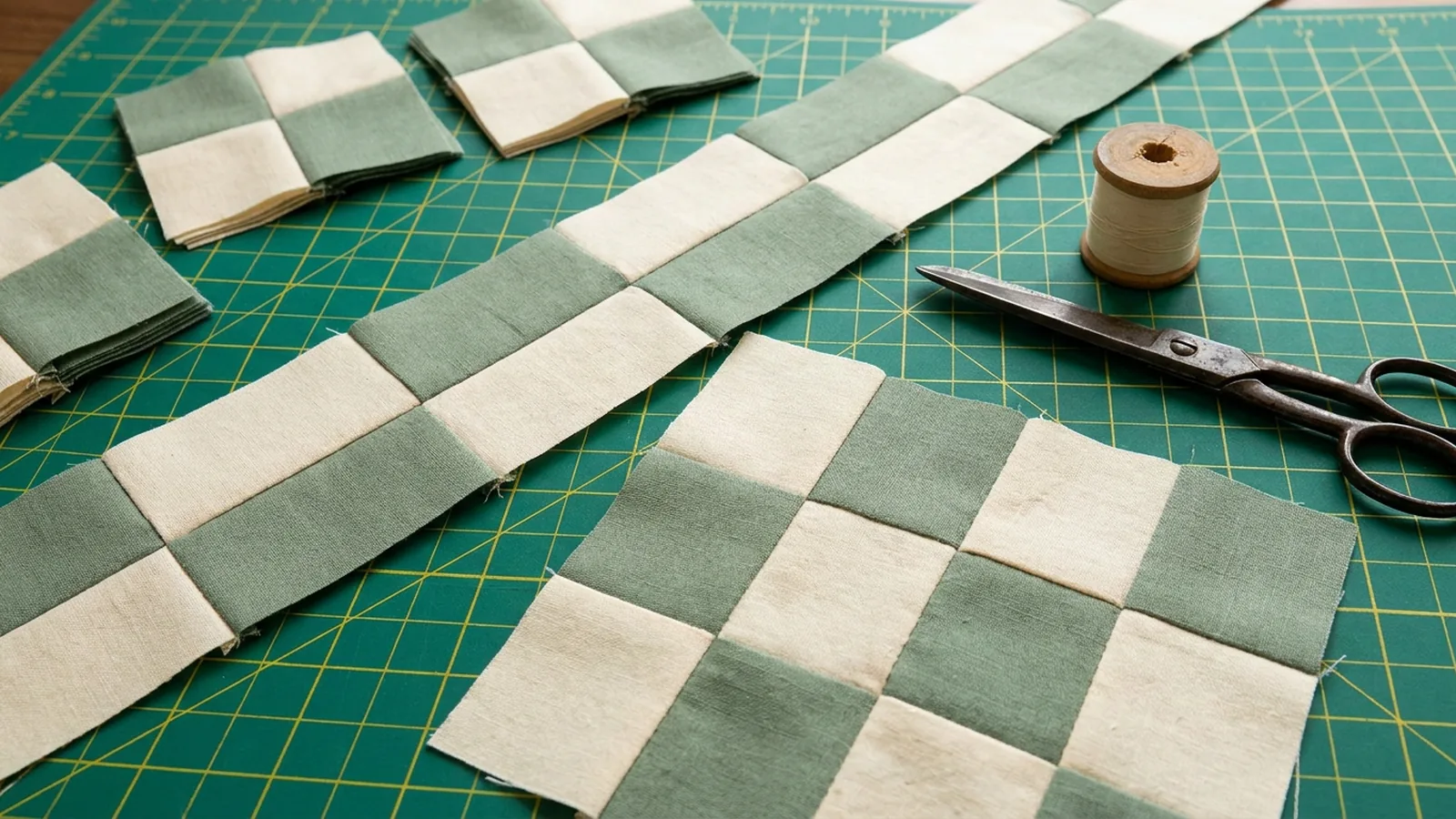
A four patch is four equal squares in a two-by-two grid. The cut size is the finished block divided by 2, plus 1/2 inch for the seam. Scrapish states that formula and a chart: a 4-inch finished block uses 2 1/2-inch squares, a 6-inch block uses 3 1/2-inch squares, an 8-inch block uses 4 1/2-inch squares, and a 12-inch block uses 6 1/2-inch squares.
Sew two pairs, press the seams in opposite directions so they nest, and sew the pairs together. String & Story spins that center seam: tease the nested seams apart so all four allowances point the same way and a tiny four patch appears on the back. A 4-inch finished four patch is the practice size on that page.
Cut sizes from the formula
Finished size is the block after it joins the quilt. Cut four squares at finished size divided by 2, plus 1/2 inch. Scrapish lists these common pairs, and each pair matches the formula.
| Finished block | Cut four squares |
|---|---|
| 4 inches | 2 1/2 inches |
| 5 inches | 3 inches |
| 6 inches | 3 1/2 inches |
| 8 inches | 4 1/2 inches |
| 9 inches | 5 inches |
| 10 inches | 5 1/2 inches |
| 12 inches | 6 1/2 inches |
Odd inch sizes work. Scrapish says you can start from 2-inch, 3-inch, 4-inch, or 5-inch squares. Turn the chart's formula around: the unfinished block is twice the cut square, minus 1/2 inch, and the finished block is twice the cut square, minus 1 inch. A 3-inch square is the chart's 5-inch finished block. Sew one test block before you cut the stack.
SewCanShe sews the 12-inch size from 6 1/2-inch strips. The tutorial makes 4 blocks that finish at 12 inches and measure 12 1/2 inches before they join the quilt. Press the seam toward the darker strip. Sub-cut the strip set at 6 1/2 inches, then sew one piece from each combination. A full width of fabric, instead of the 28-inch strips in that quiltalong, makes 6 blocks from the same strip count.
The nap square quilt offer is coming soon at $8.99.
Sixteen blocks, a 48-inch top
SewCanShe sews 16 of those 12-inch four patches into a 48-inch square baby quilt. That is four blocks on each side, with the blocks butted together. Add sashing if you want a larger throw from the same blocks.
A 10-inch four patch tiles a twin on both sides. Suzy Quilts lists a twin quilt at 70 by 90 inches. Seven 10-inch blocks span the 70 inches. Nine span the 90-inch length. Suzy says those published sizes can vary by 4 to 8 inches, so measure the mattress before you cut the last row. Other beds are on the quilt size chart.
Chain-piecing is the fast path when every block uses the same two fabrics. Sew the pairs on one thread, clip them apart, nest, and sew the second seam. String & Story also nests whole strip sets and sub-cuts them, a faster route than cutting individual squares when you need a pile of matching blocks.
Disappearing cuts and the size they finish
A disappearing four patch starts as the block above, then gets cut, turned, and resewn. Create Whimsy uses four 6 1/2-inch squares for the main sample. The finished block is approximately 11 inches square. A 5-inch charm square finishes at approximately 8 1/2 inches in the prose and at 8 inches in the page's table. The page's rule of thumb is twice the starting square, minus 2 inches, and it treats the result as approximate. Square the block you sewed. The two figures on that page are close, and they are not the same number.
For the main straight cut, measure 1 1/2 inches from each center seam and cut all four directions: above the horizontal seam, below it, left of the vertical seam, and right of it. Keep the pieces where they fell. Rotate the middle side pieces a quarter turn, sew each row, then sew the rows.
Three more ways to cut the same block
Create Whimsy shows more than one cut on the same four patch.
- Two fabrics, straight cuts. The sample above. The side rectangles turn and the center stays a small four patch.
- Four fabrics. The same 1 1/2-inch cuts on four different squares, often 5-inch charms. The lines read more clearly because each patch is a different print.
- Diagonal cuts. Cut corner to corner instead of parallel to the seams. The new edges are bias. Handle them gently so the bias stays stable, and sew them back into the block.
- A partial second cut. Make the first cut 1 1/2 inches from one center seam, then cut only the center section on the next pass and leave the outside pieces as strips. The page lines those strips up so a color forms a diagonal through the finished block.
Any of these can become a table runner, a baby quilt, or a larger top.
Projects that use only this block
A four patch quilt can be nothing but this block. The 48-inch square from sixteen 12-inch blocks is a baby quilt with no other unit to learn. The same blocks, sashed, become a throw. A disappearing four patch from 5-inch charms is the scrap version: four charms per block, cut 1 1/2 inches from the center seams, turned, and resewn. Create Whimsy also names table runners as a place for a short row of the cut blocks.
If the four patch feels too plain, set it next to a nine patch. The nine patch quilt pattern uses the same square-and-seam habits. Irish chain quilts, on the Irish chain quilt pattern page, are one traditional way those two blocks share a top. Practice the plain four patch until the center point meets, then cut one block apart. A block that misses at the center will miss again after you slice it.
The plain four patch, before any cut, is still the block to practice. The nine-patch grid that uses the same squares is on the nine patch quilt pattern page. A disappearing nine patch, which cuts a nine-unit block instead of a four-unit block, is on the disappearing nine patch quilt page.
What is a four patch quilt?
Four equal squares sewn in a two-by-two grid. It is a block on its own, and it is the unit inside many larger blocks.
What are some good four-patch quilt patterns for beginners?
A plain checkerboard of 12-inch blocks, sixteen of which make a 48-inch square in one free tutorial, and a disappearing four patch cut 1 1/2 inches from the center seams.
What are some variations of the Disappearing 4 patch quilt?
Two fabrics with straight cuts, four fabrics, a diagonal cut that puts edges on the bias, and a cut that slices only the center on the second pass.