
Vintage Quilt Patterns: What the Word Means, and Blocks That Look Old
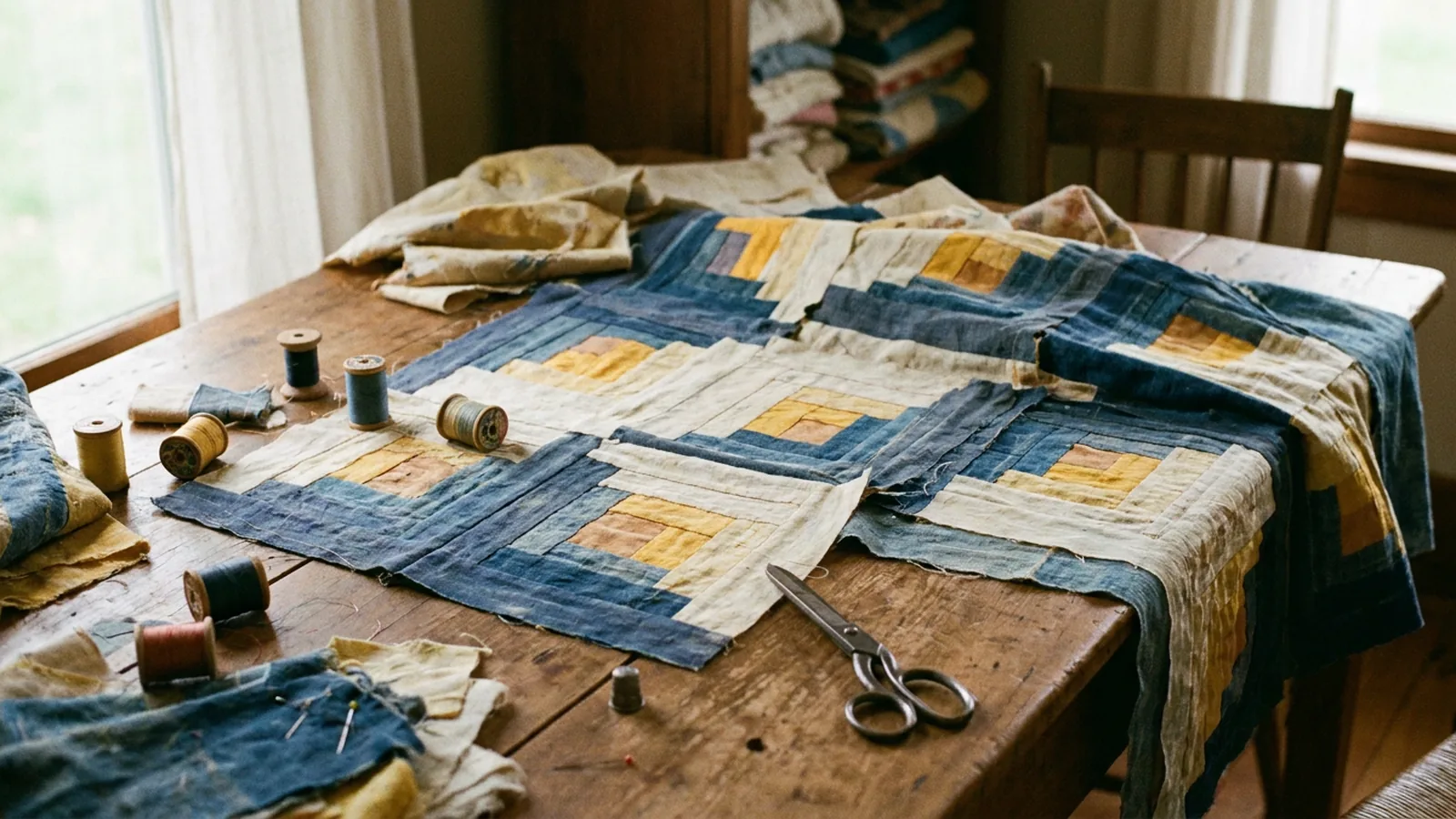
Published 2026-10-15. Updated 2026-10-15.
A vintage look starts with a named traditional block and cloth that copies an older print, on a quilt you sew now. Clara A. Stone's Practical Needlework quilt booklet, scanned by the Antique Pattern Library, names Aunt Mary's Double Irish Chain, Grandmother's Irish Chain, Grandma's Star, Lone Star, Rising Sun, Flower Basket, Fox and Geese, Cross and Crown, and Diamond Ring. The Quilt Show says fabric manufacturers have reproduced many antique fabric designs for current-day use. Reproduction cloth does not make that newly sewn quilt antique. Age labels are a separate question, after the pattern list.
Named blocks from an old booklet
"What are some vintage quilt patterns?" is a list question. One public-domain answer is Clara A. Stone's Practical Needlework quilt booklet, issued in Boston and scanned by the Antique Pattern Library. The scan is a name list and diagrams, not a modern cutting chart. These names are printed clearly enough to read in that scan:
- Aunt Mary's Double Irish Chain
- Grandmother's Irish Chain
- Grandma's Star
- Lone Star
- Moon and Star
- Rising Sun
- Flower Basket
- Fox and Geese
- Cross and Crown
- Diamond Ring
- Diamond Star
- Double Star
- Kentucky Chain
- Baltimore Belle
The booklet numbers many more blocks. Treat OCR-garbled lines in the scan as unread. Do not sew from a name you cannot match to a clear diagram on the page.
The Quilt Show adds two designs that antique quilts still pass down: Feathered Stars and Mariner's Compass. Those are complex. For a vintage look with straight seams, the Irish chain names above are the closer start. The Irish chain quilt pattern is a modern straight-seam lesson, not a page from Stone's booklet. A log cabin quilt pattern is another classic set people reach for when they want an old look. Stone's scanned list, as read here, does not include that name, so do not treat a new cabin as a Stone block.
A newly pieced cabin can borrow an old idea and still be a new quilt.
hearth cabin quilt at $8.99, coming soon.
Fabric that looks old, and a quilt that is new
The Quilt Show says many of today's quilters like to replicate antique quilts, often closely, and that fabric manufacturers have reproduced many antique fabric designs for current-day use. That is the cloth side of a vintage look: small-scale prints copied from older dress goods, not a large novelty print that shouts its year.
Reproduction cloth leaves the sewing date where it is. PieceWork's point is the practical one. A new top in reproduced antique prints can look like an older quilt and still be a quilt from this year. If you want the next owner to know the difference, do what the Quilt Show asks of makers now: sign the quilt with who made it, who quilted it, when, and where. An unsigned new quilt in old-looking cloth is the case that gets mislabeled later.
Photographs from museums and dealers can guide color, the Quilt Show says, and some museums have published patterns of quilts in their collections. A published pattern of an old quilt is a new set of instructions. The antique is the quilt that was already old when the pattern was drawn.
How to use an old name on a new quilt
Pick one block from the list you can draw from the scan, not from memory of the name. Irish chain blocks are a straight-seam start. Rising Sun and Lone Star are the showier names, and they ask for more precise points. Feathered Star and Mariner's Compass, the two the Quilt Show still sees in use, are the complex end. Sew a sample block before you cut a bed.
If the scan's diagram is too faint to follow, use the name only as a shopping list for a modern lesson of the same block. Irish chain and a star are the two families in that booklet that a straight-seam quilter can start this week. The point of the list is the names, not a promise that every historical block is beginner work.
Color comes from the reproduced antique prints the Quilt Show describes, or from a museum photograph used as a guide. Keep the new quilt signed. The Quilt Show's request is practical: who made it, who quilted it, when, and where. That label is what stops a later owner from calling a new top an antique because the prints look old.
A trip around the world quilt is another straight-seam set with an old-fashioned grid, if the Stone names feel too diagram-heavy for a first top. It is a modern lesson, not a page from the booklet.
What the labels actually cover
The Quilt Show's Quiltipedia says antique quilts are generally more than 100 years old, and that quilts made from the 1920s to 1950 are considered vintage. PieceWork says some dealers use at least 100 years for the word antique, and labels a Sunbonnet Sue block from about 1940 vintage because that block is less than 100 years old. Those are two published usages, kept separate. Vintage and antique are not treated here as exclusive groups, and under 100 years is not treated here as a vintage category for every quilt. PieceWork's caption on the same page marks a current sewing bird NEW.
Age is the quilt, not the pattern name. The Quilt Show says old quilts are rarely dated, so a date is an educated reading of piecing, pattern, fabric weave and color, and batting. PieceWork says a dictionary sense of antique can mean merely "from earlier times," which is why the word gets muddy, and that dealers, insurers, lawyers, and museum staff may each use a different cutoff. Ask the person who needs the label. A sale, an appraisal, and a museum gift are not the same question.
PieceWork also says reproductions make age harder to read, because an object can be made in the style of an earlier period. The magazine's own captions split one family of sewing birds into antique, vintage, and new. The same split applies to a quilt: cloth, stitch, and date have to agree before the label does.
The honest limit: these two pages do not share one cutoff. The Quilt Show's vintage group is the 1920s to 1950, stated beside its antique convention of more than 100 years. PieceWork pairs a dealer antique line of at least 100 years with vintage labels on specific objects, including a block from about 1940, and marks a current sewing bird NEW. Under 100 years is not, on that page, a vintage category for every object. Neither page is a statute. If you are insuring or selling, use the buyer's or the museum's definition, not a joined summary of these two.
What is considered a vintage quilt?
The Quilt Show calls quilts made from the 1920s to 1950 vintage, and calls antique quilts those more than 100 years old. PieceWork says some dealers use at least 100 years for antique, and labels one block from about 1940 vintage because that block is less than 100 years old. Those are separate usages, not one exclusive age scale.
What are some vintage quilt patterns?
Clara A. Stone's Practical Needlework quilt booklet, scanned by the Antique Pattern Library, names blocks such as Aunt Mary's Double Irish Chain, Grandmother's Irish Chain, Grandma's Star, Lone Star, Rising Sun, Flower Basket, Fox and Geese, Cross and Crown, and Diamond Ring. The Quilt Show also names Feathered Stars and Mariner's Compass as antique designs still pieced today.
Does a new quilt in old-looking fabric count as an antique?
No. Antique, on the Quilt Show's page, means the quilt itself is more than 100 years old. Reproduction cloth can copy an old print. The sewing date stays the year you piece the top.