
Trip around the world quilt: squares, strip sets, and fabric
Published 2026-10-15. Updated 2026-10-15.
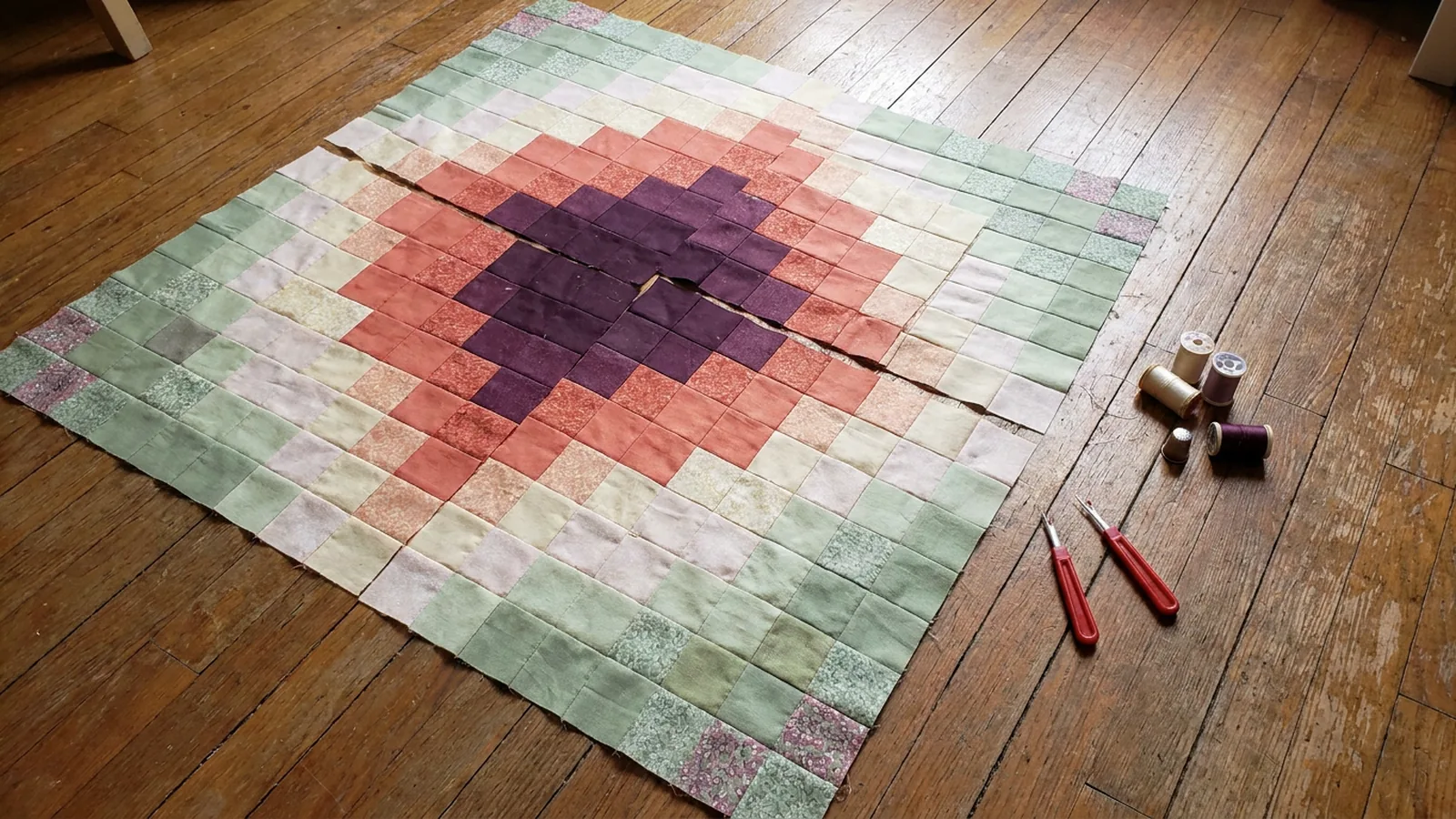
A trip around the world quilt is rows of squares that read as diamonds from the center out. Two ways get you there, and they do not use the same square count.
The strip-set way: one 12 inch block is 36 squares. Quiltville sews 6 strips, cuts 6 segments, and unpicks the tube so the colors stair-step. A 10 inch block on that page uses 5 strips, which is 25 squares. Madison Rose Quilting Co sews 25 of the 12 inch blocks, 5 across and 5 down, and the top finishes at 60 by 60 inches. That is 900 squares.
The single-square way: Tales of Cloth stitched 25 rounds of English paper pieced squares and used 2,601 squares for a 90 inch square. That count is the whole top, including the corner fill, not a per-block figure.
Strip sets, then a stair-step
Quiltville's free tutorial is the strip-set method quilters call scrappy trips. For one 12 inch block, cut 6 rectangles, 2.5 by 16 inches, in contrasting values. From a fat quarter, leave them 18 inches and skip the trim. Sew the 6 strips into a panel. Press seams toward every other strip. Fold the panel and sew the first strip to the last, making a tube. Cut the tube into 6 segments of 2.5 inches. Open each loop at a different seam so each color steps up one square. Sew the rows with a ¼ inch seam.
The block is unfinished until those seams are in. Use the ¼ inch seam the page specifies, and a stitch length around 2.5, because you will unpick one seam in every loop. Measure the unfinished block after the rows are sewn.
Quilty Love, the first result for this search, follows that Quiltville tutorial and cuts 2.5 by 18 inch strips. The post does not give a square count or a finished size for either quilt. The 36-square block and the 60 inch top are not on that page.
A smaller block is the same idea with fewer strips. Quiltville's 10 inch block uses 5 strips instead of 6. One reader quilt on that page, set in a barn raising, measures 100 by 100 inches. That is an example, not the default.
Press the strip set before you cut the tube. Quiltville presses seams toward every other strip so the stair-step rows butt when you join them. After the block is together, those row seams can all go one way, because the next block may rotate. Madison Rose presses the finished block seams open. Either press works if you pin the color steps. The diamond shows when a light sits next to a dark and that pair repeats. Six similar prints in one block read as a square, not as a trip.
A fat quarter gives you the 18 inch length Quiltville allows, which is also the length Quilty Love cuts. You do not have to trim those to 16 inches. The extra length is scrap after the tube is squared, and it can wait for a pieced border.
Single squares, round by round
Tales of Cloth built the traditional diamond by stitching squares, round after round, with English paper piecing. The writer chose 3 or 4 rounds at a time, used a fat quarter bundle plus matching stash, and stopped at 25 rounds before filling the corners. The finish was 90 inches square and 2,601 squares. The shop pattern on that page includes a 61 inch size plus a table for going bigger. This guide does not copy that table. The captured post states the 61 inch size and the 90 inch quilt, not the yardage for each round.
A paid pattern is a third option, not a free tutorial. Busy Hands Quilts sells Around the World at $12.99, in baby, lap, throw, and queen, and asks for 10 coordinating fabrics plus a bold contrast. Piece sizes change by quilt size. The page does not list yardage. Ten fabrics is a planned palette. It is not the scrappy 6-fabric block, and it is not Tales of Cloth's 2,601 squares.
Fabric for one size you can copy
For the strip-set 60 by 60 inch top, Madison Rose states the amounts in the tutorial:
| Piece | Amount on that page |
|---|---|
| Top | 24 fat quarters |
| Rectangles | 150 pieces, 2.5 by 15 inches |
| Blocks | 25 blocks, each 12.5 inches unfinished |
| Backing | 4 yards |
| Binding | 1/2 yard, cut as 7 strips of 2.5 inches by the width of fabric |
Each block uses 6 rectangles. Twenty-five blocks use 150 rectangles, which is the count on the page, not a guess. Eighteen of the fat quarters yield 6 rectangles each, and 6 of them yield 7, which is how 24 fat quarters become 150 strips. Cut a 15 inch square from each of 18 fat quarters and slice six 2.5 inch strips. The other 6 fat quarters are cut a little longer so you get 7 strips.
That top is a throw. It is not the 90 inch single-square quilt, and the fabric will not match if you switch methods. A 12 inch strip-set block and a paper-pieced round do not share a cutting chart.
Free patterns: Quiltville's tutorial and Madison Rose's tutorial are both free to read. Busy Hands is the paid file at $12.99. Use the free pages if you want to sew today. Buy a pattern only if you want a size chart you did not calculate.
Not this diamond
These counts are for trip around the world, strip-set or single square. A charm-pack quilt of large plain squares is a different design.
Our small hours quilt: $8.99, coming soon.
If you are choosing square size before you cut, the charm pack guide and the quilt size chart sit next to this decision. A scrap bin of 2.5 inch strips is also the start of the scrap quilt guide.
Is there a free pattern for the Trip Around the World quilt?
Yes. Quiltville publishes a free strip-set tutorial for a 12 inch block, and Madison Rose Quilting Co publishes a free tutorial for a 60 by 60 inch top. Busy Hands Quilts sells a separate pattern at $12.99 with baby, lap, throw, and queen sizes.
How much fabric do I need for a trip around the world quilt?
For a 60 by 60 inch strip-set top, Madison Rose uses 24 fat quarters, 4 yards of backing, and 1/2 yard of binding cut into 7 strips of 2.5 by the width of fabric. A single-square queen on Tales of Cloth used a fat quarter bundle plus stash, not a fixed yardage chart.
How many fabrics for a trip around the world quilt?
A scrappy strip-set block uses 6 fabrics in that block. A 60 inch top on Madison Rose used 24 fat quarters. A planned color-round quilt can be about 10 fabrics, which is what Busy Hands Quilts asks you to choose. More rounds mean more fabrics.