
Jelly roll race quilt: size from one roll, and how to sew it
Published 2026-10-15. Updated 2026-10-15.
One 40-strip jelly roll makes a throw, not a bed quilt. Crafty House starts with 40 strips, each 2½ inches by 45 inches, and after the last cut-and-sew states a top of about 64½ by 50 inches. Wee Folk Art states a standard race top of about 50 by 60 inches, from strips of about 42 inches rounded to 40 inches of usable length and a 1600 inch mega-strip. Those are the sizes the two pages publish. Do not treat the larger figure as the result of cutting the unit in half instead of folding. Both pages halve a strip of about 1600 inches down to about 50 inches.
To make a bed quilt, add strips before the first fold. Wee Folk Art's queen example uses 96 strips, which is 3 jelly rolls of 40 strips each, for a top about 80 by 96 inches. A smaller baby top on that same page uses 17 strips for about 42 by 32 inches.
Join the strips, then fold
A jelly roll is a bundle of 2½ inch strips. Wise Craft Handmade, the first written result for this search, says a roll usually has 30 to 40 strips, each about 44 inches long, and that one roll can make a lap or baby quilt. To go bigger, that page says to add more strips. It does not state a finished width and length.
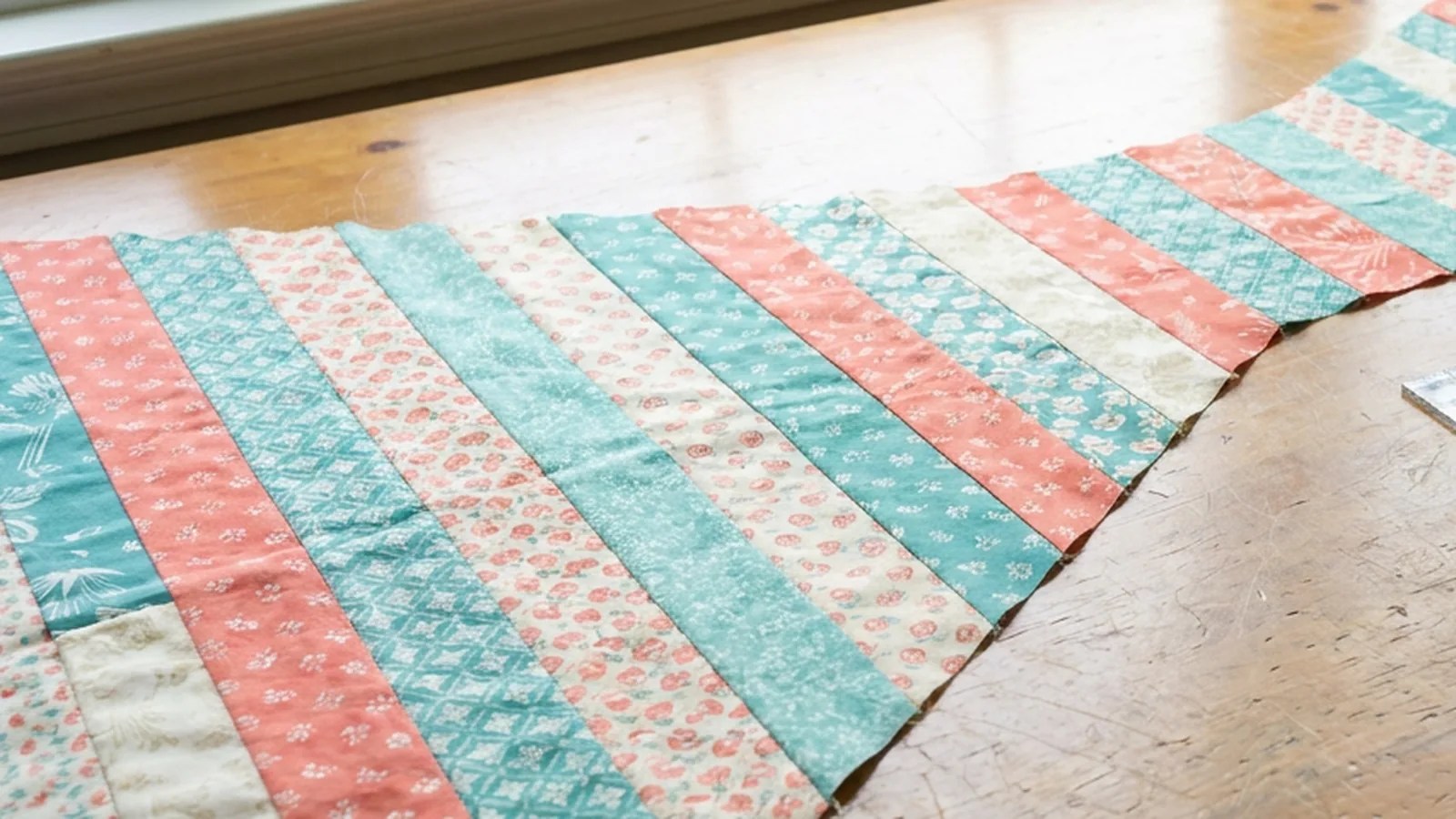
Sew the short ends together. Cross two ends at a right angle and stitch a 45 degree line, then trim the seam allowance to ¼ inch. Wise Craft's own long strip, from 40 to 45 strips, was about 1600 inches. Fold that strip in half, sew the long edges with a ¼ inch seam, and cut the fold. That first fold made an 800 inch strip on that page. Repeat: fold, sew the long edges, cut the fold. Each pass makes the piece shorter and wider. Stop when the rectangle is the size you want, then press and square the edges before you add batting.
K Middleton Design Studios trims about 18 inches off one end of the long strip before the first fold. The trim offsets the diagonal joins. That tutorial uses a 20-count roll and says a baby top usually needs 4 turns. A 20-count roll is half a 40-strip roll. Use the 4-turn note only with the smaller roll.
The size, pass by pass
Crafty House writes the widths after each sew. The halves below are that page's figures, not a second method.
| Pass | About how long | About how wide |
|---|---|---|
| Strips joined end to end | 1600 inches | 2½ inches |
| First long seam | 800 inches | 4½ inches |
| Second long seam | 400 inches | 8½ inches |
| Third long seam | 200 inches | 16½ inches |
| Fourth long seam | 100 inches | 32½ inches |
| Cut in half and sew the halves | 50 inches | 64½ inches |
Wee Folk Art also starts from a 1600 inch mega-strip, 40 strips at 40 usable inches, and a fold sequence that reaches a 50 inch side. That page counts each finished row as 2 inches, from a 2.5 inch strip with a ¼ inch seam on each long edge, and its chart says 32 rows are 64 inches tall. It still states the standard top as about 50 by 60. Wee Folk Art publishes 64 and 60 as separate figures. Crafty House publishes 64½ beside them. Cutting the unit in half and sewing the halves, which is Crafty House's last line, doubles the rows the same way a fold does. Keep both published sizes as approximations. What those pages do state about length is the strip they start from: 45 inches on Crafty House, and about 42 inches rounded to 40 usable inches on Wee Folk Art, for the selvage and a ¼ inch seam on each end.
The honest limit: both pages are approximations. A wider seam, a shorter width of fabric, or a diagonal join that eats more than you planned will shrink the top. Measure the piece after the third fold, before you commit to the last seam. You cannot unfold a race top and recut it.
Making it larger without a surprise length
Every fold doubles the number of rows and halves the length. That is why a bed-size race is not "one more fold" of a throw. Wee Folk Art works backward from the width you want.
The formula on that page is inches of finished width, times the number of rows, divided by a 40 inch strip. For an 80 inch width and 32 rows, that is 64 strips, and the length is about 64 inches if each row finishes at 2 inches. To add length without a 64-row top, sew a second, shorter race section and join it to the first. Sixteen more rows add 32 inches. That second section needs 32 strips. Together, 96 strips. Three jelly rolls of 40 strips cover that queen example, about 80 by 96 inches, with the strips running across the width.
A baby top on the same page is 42 by 32 inches, 16 rows, and 17 strips. One yard of backing is what that writer uses for that small size. It is not a full-roll project.
If you only want a bit more than the throw, add a border instead of a second section. Wee Folk Art notes that a border on the 50 by 60 inch top can carry it toward a full bed. The race itself stays one roll.
Set aside binding strips before you join the roll if you want the binding to match. For the 50 by 60 inch top, that page figures a 220 inch perimeter and about 6 strips of binding. Those strips never enter the race, or the top comes up short.
What this is not
The race is one long seam repeated. It does not give you a block, a layout choice, or a fabric chart for crib through king. If you want a strip quilt with a planned size list instead of a race, that is a different design.
Our lane strip quilt: $8.99, coming soon.
After the top is square, the next job is the edge finish. The binding guide covers that step. A jelly roll quilt guide is the place to compare other ways to use the same strips, including a rail fence if you would rather cut the strips into blocks.
What size quilt does a jelly roll race make?
One 40-strip roll finishes as a throw, not a bed quilt. Crafty House states about 64½ by 50 inches. Wee Folk Art states about 50 by 60 inches. Those are the sizes those pages publish. They do not show a last step that turns one figure into the other.
How to make a jelly roll race quilt step by step?
Join the short ends on a diagonal, fold the long strip in half, sew the long edges, cut the fold, and repeat until the top is the size you want. Stop after the step that matches your target, then square the edges.
How do I make a jelly roll race bigger than one roll?
Add strips before you start folding. Wee Folk Art's queen example uses 96 strips, three rolls of 40, for about 80 by 96 inches, built as two sections rather than one more fold of the throw.