
Hidden wells quilt: strip set, square size, and jelly rolls
Published 2026-10-15. Updated 2026-10-15.
A hidden wells block is a strip set recut into squares, then cut on both diagonals. MooseStash Quilting cuts five fabrics into 1½ inch strips, sews them with a ¼ inch seam, and says a typical set of five 1½ inch strips measures 5½ inches wide. Cut 5½ inch squares from that set. Those squares are the block units before the diagonal cuts. The square is whatever your set measures. If your seams are off, the set will not be 5½ inches, and the squares will not match.
A table runner can start small. That tutorial uses as little as ¼ yard of five fabrics, and four strip sets of one strip from each fabric. From fat quarters, the writer got 3 squares from each 5½ inch set. From full 45 inch width strips, the same page gets 7 squares per set. Those 7 squares belong to that measured 5½ inch set only.
Three sizes, not one square
The 5½ inch figure is the cutting square. It is not the finished block.
The cutting square comes first. Five 1½ inch strips and four ¼ inch seams are what that page sews, and it measures the set at 5½ inches. Cut squares to the width you measure. This is the square before the diagonal cuts.
The paired unit comes next. Each square is cut on both diagonals, into four triangles. Two triangles are sewn together. The page trims the dog ears after pressing. It does not state a second seam width for that join, and it does not state the inches of the pressed pair. The only seam width on the page is the ¼ inch used to build the strip set.
The assembled block is four of those paired units. MooseStash arranges one block as A/D with A/B over A/B with A/D, and a second block as C/D with C/B over C/B with C/D. That four-unit arrangement is the block. The page does not state its finished inches. Do not sew the 5½ inch cutting square into the quilt as if it were already the block. DIY Joy uses a different cut, two 8 1/2 inch squares sewn all the way around and then sliced, and it says to trim the opened pieces, leaving the trimmed inches unstated.
Cut, slice, and keep four piles
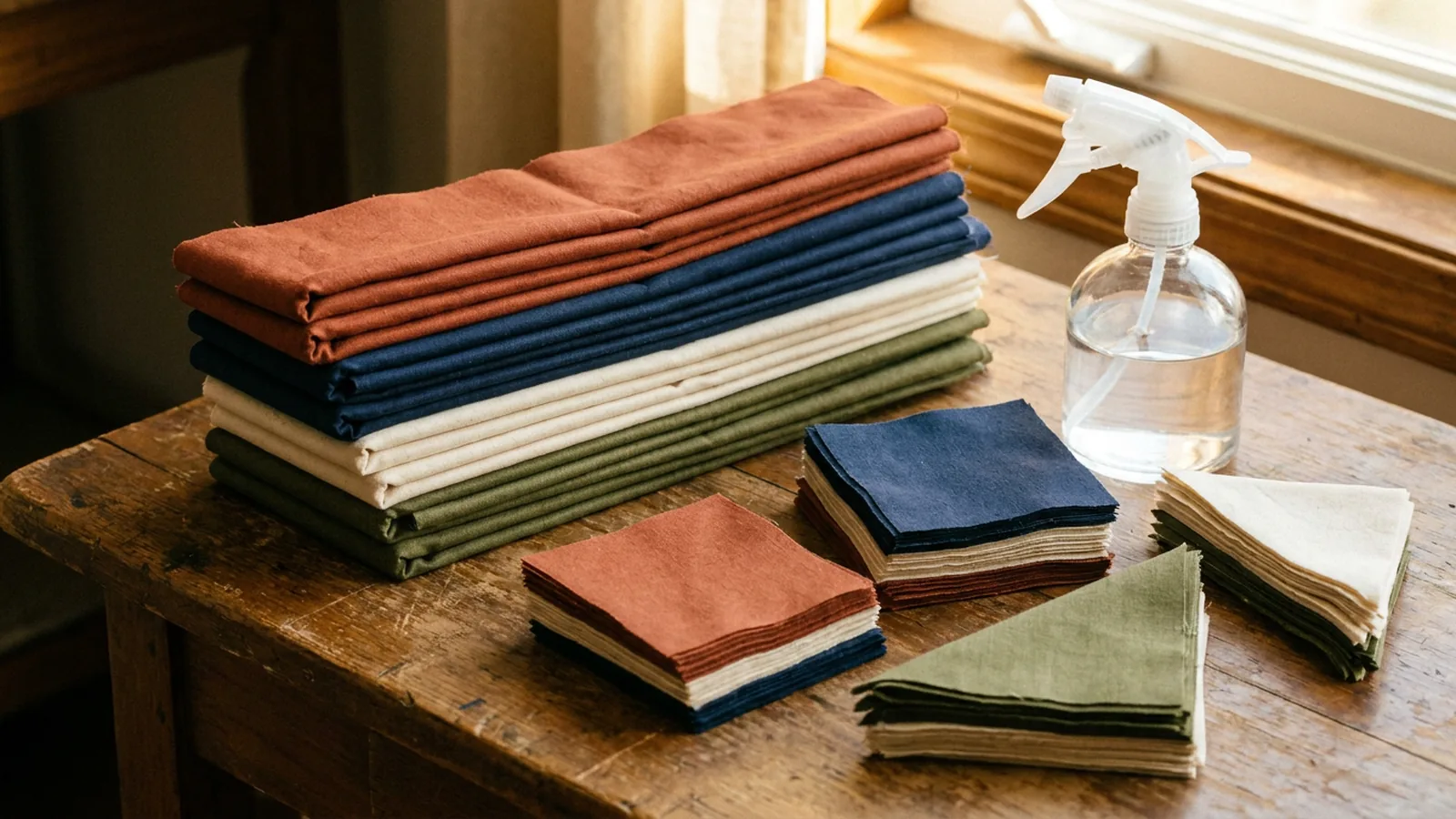
Starch the fabric before you cut. The diagonal cuts leave bias edges, and MooseStash Quilting treats starch as required, not optional. Spray both sides and let the fabric dry flat.
Sew the five strips in the same order on every set. Press all seams the same direction. Measure the set. Cut squares equal to that width, and square the end of the set if it drifted.
Cut each square on both diagonals. You now have four triangles. Keep them in four piles, labeled so a pile stays in its place. MooseStash pairs them as A with B, A with D, C with B, and C with D. The triangle on the bed of the machine has its strips running up and down, so the seams of the triangle on top can be flipped down as you sew. Press the pairs so the seams oppose, trim the dog ears, and then lay the blocks out. The first and last strips in the set become the two diamond shapes. A wider center strip keeps those center bits from turning into tiny dots.
Teresa Down Under credits the method to Mary Ellen Hopkins in 1989 and uses five strips of different widths, or the same width. An earlier page on that site shows blocks with 3, 4, 5, and 7 strips. MooseStash says an odd count is a must, so a seam does not run down the center of the set, and calls five strips right for a table runner and seven for a larger quilt. Both can be true: an even count still makes a block, as the four-strip examples show, and the center of that block is a seam. Use an odd count when you want a fabric strip in the middle.
After the triangles are paired, the layout is a choice. MooseStash Quilting uses the tiny outer triangles of two chosen fabrics as a landmark, so each block stays turned the same way down a row. Step back after a row. A block spun the wrong way breaks the diamond, and it is easier to see from a few feet away than at the machine. Leftover blocks from the same sets can become a small mat. That page shows the mat as a use for extras, not as a second pattern with its own cut.
Press the pairs before you join them. The page presses seams so they oppose, which lets the next seam lock. If a row will not match, pin or baste that join, then stitch again. Pulling a bias edge to force a match stretches the square, and the next row will show it.
How many jelly rolls
No jelly-roll count is on the hidden wells pages opened here. Wise Craft Handmade describes a jelly roll as 2½ inch by 44 inch strips, usually 30 to 40 in a roll. That width is not the 1½ inch cut in the table-runner tutorial. A roll will not drop into that cutting list.
If you want hidden wells from 2½ inch strips, the set will finish wider than 5½ inches, and you cut the square to the width you measure. Count strip sets, not rolls. Five fabrics still means five strips per set. Four sets are the table-runner start on MooseStash's page. A larger quilt is more sets. Do not reuse the 7 squares from a 45 inch width on a wider set. That yield is only for the measured 5½ inch set of five 1½ inch strips.
Seven 1½ inch strips, with a ¼ inch seam on each join, calculate to 7.5 inches wide before any diagonal cut. A 45 inch strip holds at most 6 squares of that width. Five 2½ inch strips calculate to 10.5 inches wide, and a 45 inch strip holds at most 4 squares. Those widths and yields are seam math, not counts the page measured. The measured 5½ inch set shows why the bound is not a promise: a 45 inch strip is long enough for more than 7 squares of 5½ inches, and the page still got 7 after squaring the end. Measure the set you sewed. The opened tutorials do not publish a bed-size roll chart. The jelly roll quilt guide is where strip-count planning for a roll belongs.
DIY Joy describes a different cut: sew four strips, cut two 8 1/2 inch blocks, sew them right sides together all the way around, then cut corner to corner twice. That square is 8 1/2 inches, not 5½. The page then says to trim the opened pieces, and it does not state the trimmed size or the size of the block those pieces make. Do not mix the two cutting lists in one quilt.
What to decide before you cut
Pick high contrast. MooseStash says the quilt wants variety, and that matching colors too closely flattens the diamonds. The first and last fabrics drive the two diamond shapes, so put the fabrics you want to see there, not in the middle.
Press as you go. The triangles will not lock if the seam directions are random. If a row will not match, pin or baste, then stitch again. Bias edges stretch if you pull them through the machine.
The honest limit: the 5½ inch square is MooseStash's measurement for 1½ inch strips and a careful ¼ inch seam. It is not a universal block size. Measure the set you sewed. The yardage charts on the older Waterworld page that tutorial points to were not in the text captured from that archive, so this guide does not repeat a bed-size fabric table it could not read.
A separate strip option
Hidden wells is a sliced strip set. A straight strip quilt is a different design.
Read the lane strip quilt page, coming soon at $8.99.
If you want another strip block that stays in rectangles, the rail fence guide is the next cut. A sliced nine-patch, which also recuts a sewn unit, is in the disappearing nine patch guide.
How many jelly rolls for a hidden wells quilt?
The captured hidden wells tutorials state no jelly-roll count. A roll is usually 30 to 40 strips of 2 1/2 by 44 inches. The table-runner method uses a narrower strip from yardage, so a roll is the wrong width for that cut.
How do I make a hidden wells quilt from strip sets?
Sew an odd number of strips into a set, cut squares the width of the set, and cut each square on both diagonals. Pair the triangles in four piles so the seams lock, then play with the layout before you sew rows.
What size is a hidden wells block?
MooseStash Quilting measures a five-strip set of 1½ inch strips at 5½ inches and cuts 5½ inch squares. That figure is the cutting square, before the diagonal cuts. Two triangles are then sewn and the dog ears are trimmed; that page does not state the paired unit's inches. Four of those paired units make the block, and the page does not state that block's finished inches. DIY Joy's 8 1/2 inch squares are a different cut, and that page trims after opening while leaving the trimmed inches unstated.