
Disappearing Nine Patch Quilt: Start Size to Finished Size
Published 2026-10-15. Updated 2026-10-15.
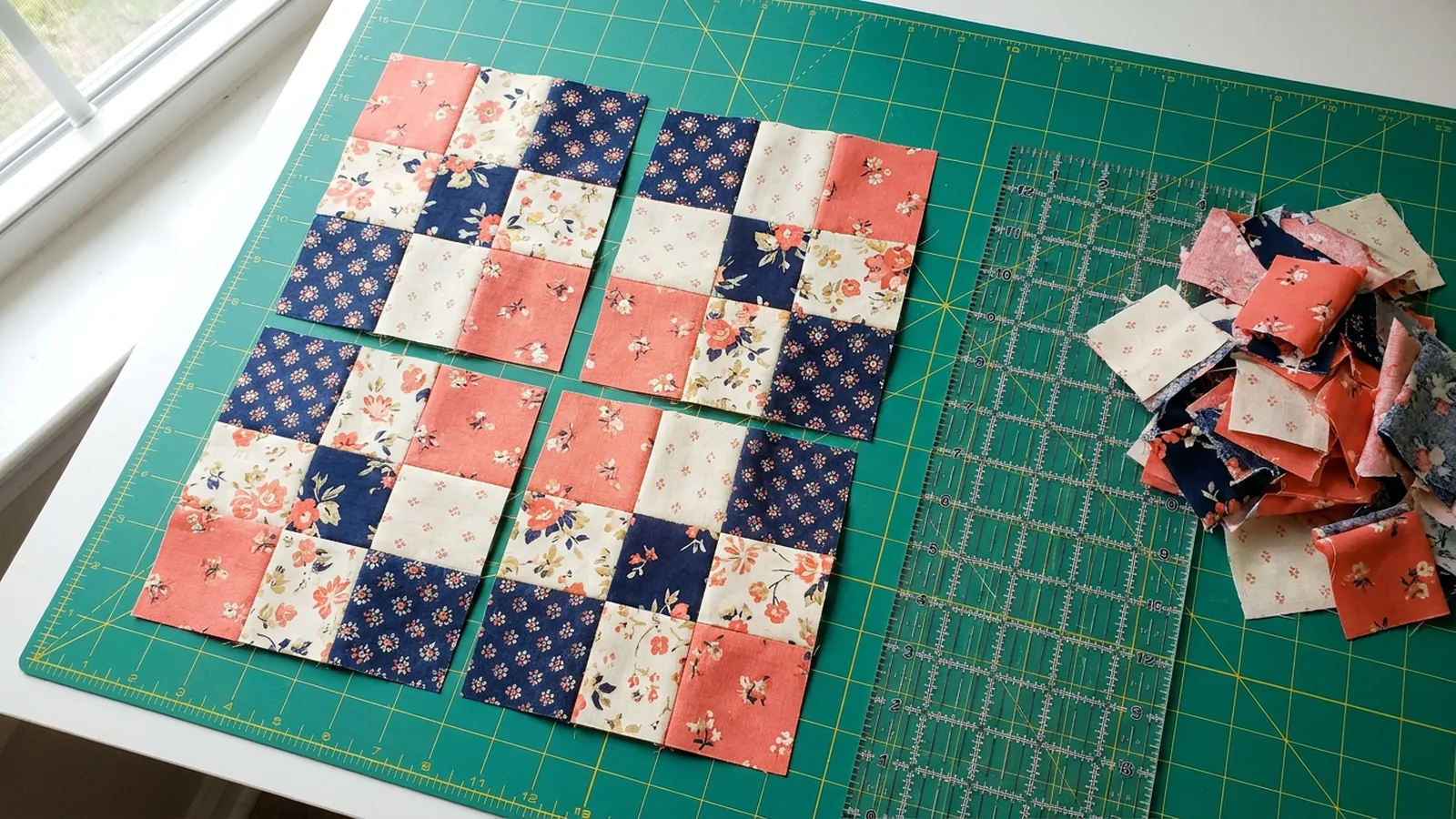
Sew an ordinary nine patch, cut it through the center both ways, and sew the four pieces back together in a new order. The block you get is smaller than three times the starting square, because every seam removes cloth. Raeven Fea prints the short formula: square size times 3, minus 2 inches. A 3-inch square finishes at 7 inches. A 5-inch square finishes at 13 inches. Both pairs are on that page's table.
The nine patch itself is the nine patch quilt pattern. This page is only the cut-and-turn that follows.
From a 5-inch square to 13 inches
Charm squares and many precuts are 5 inches. Chicken Scratch NY names 2.5-inch, 5-inch, and 10-inch squares as the easy precut starts. Raeven Fea's table puts a 5-inch start at a 13-inch finished disappearing block, and a 2.5-inch start at 5.5 inches finished. A 10-inch start is on that table at 28 inches finished, which is a big block for a lap and a useful one for a medallion center.
Use the short formula when your square is not on the table. Multiply by 3, then subtract 2 inches. That 2 inches is the seam cloth the page accounts for: the nine-patch seams, the seam that joins the four cut pieces, and the seam that joins the finished block into the quilt. Some common finished sizes, including 6, 8, and 12 inches, put the starting square on a third of an inch, which is why that chart leaves them off. Rounding up to the next eighth and using a generous quarter-inch seam on the nine patch is the workaround that page offers. Measure the block before you cut it apart.
See the nap square quilt coming soon at $8.99.
The printed 3-inch walkthrough
Raeven Fea walks a 3-inch square all the way through, which is the check on the formula.
Add a row of squares: 3 times 3 pieces is 9 inches. Subtract the two row seams, 1/2 inch each, which is 1 inch: 9 minus 1 is 8 inches. Subtract the four-patch seam, another 1/2 inch: 8 minus 1/2 is 7.5 inches. Subtract the last 1/2 inch, the seam that joins this block to the next: 7.5 minus 1/2 is 7 inches finished.
That is the same 7 inches as the short formula, 3 times 3 minus 2. If your ruler says something else, the seam is not a quarter inch. The page's comment reply makes the same point on a different start: a 3.5-inch square should measure 9 inches unfinished, and 8.5 inches once the blocks are sewn together. The table lists 8.5 inches finished for that 3.5-inch start. A 9-inch reading on a 3.5-inch start is the raw block, not a mistake, if the seams are a true 1/4 inch.
Square the nine patch before the cut, which is what Raeven Fea prefers, or square the four pieces after. Either order works. Squaring first is less trimming.
Turning the four pieces
Patchwork Posse starts with 9 squares at 5 by 5 inches, sews the nine patch, and cuts down the center top to bottom and side to side. The design is the rotation after that cut. If every corner of the nine patch was the same fabric, those corners meet neighboring blocks and can read as a four patch. That secondary block is the reason to decide the layout before you sew the quilt together.
Chicken Scratch NY keeps the uncut squares for a large print, halves the side squares, and quarters the center. A stripe on the side squares should run the same way on the top and bottom and the other way on the sides, or the cut will flip the stripe. Rotate the finished pieces to make split nine patches or framed squares. An I-spy version puts a different print in every large square and keeps one fabric in the pieces that get cut. Using the same center fabric in every block is what makes those secondary shapes line up.
Free Motion Project played through several rotations, including a layout with one solid background. That solid version, drawn in EQ7, used about 2 1/2 yards of white instead of the ten solid fat quarters in the scrappy version. The rotation, not a new cut, is what changes the quilt.
One measured quilt
Upcycle My Stuff finished a scrappy disappearing nine patch at 61 by 77 inches, a bit larger than a full or double in that maker's house, and put it on a guest bed. The blocks came from 5-inch precuts. That maker measured the blocks at 11 3/4 inches finished before sashing, and wrote that a 12-inch result was probably intended. Sashing and borders changed the quilt size. Those measured blocks are separate from the 13-inch result on Raeven Fea's table.
Press the nine patch flat before you cut. A wavy center cut makes the four pieces different sizes, and the later seams will not nest. If the pieces disagree, square them to the smallest one and accept a slightly smaller block, which is what one reader on the Patchwork Posse page had to do after the cuts missed.
What the finished blocks are good for
A 13-inch finished block from 5-inch squares is large enough that a few of them make a table runner or a crib top, and a field of them makes a lap. The 61 by 77 inch quilt on Upcycle My Stuff is a separate measured quilt: its blocks were reported at 11 3/4 inches before sashing. If you want the block to land on a bed size exactly, go back to the short formula and pick a starting square whose finished size divides the bed, or plan a border from the start.
Keep one fabric in the pieces that get cut if you want the secondary four patch to show. Mix those pieces if you want the quilt to read as scraps. Both layouts use the same cut. The only change is which square you put in the center before you sew the nine patch.
The four patch that appears where corners meet is the same unit as a four patch quilt pattern. Sew that simple block first if the nine patch rows are still new.
What size does a disappearing nine patch finish?
On Raeven Fea's table, 5-inch starting squares finish at 13 inches, and 3-inch squares finish at 7 inches. The short formula is the starting square times 3, minus 2 inches.
If I start with 3.5-inch squares, why is my block 9 inches?
A proper 1/4-inch seam makes that nine patch 9 inches unfinished. It finishes at 8.5 inches after the blocks are sewn together. Raeven Fea's table lists 8.5 inches for a 3.5-inch start.
When do I square the blocks?
Square the nine patch before you cut it into four, or square the four pieces after. Raeven Fea squares before the cut because it is less trimming.
How do I lay out the cut pieces?
Rotate the side rectangles, keep the center quarters as small squares, and sew the four pieces back as a four patch. Turning neighboring blocks makes a secondary pattern where they meet.