
Tumbler quilt pattern: cut charms without a template
Published 2026-10-15. Updated 2026-10-15.
Cut a tumbler from a five inch charm square with a ruler, not a plastic template. The Quilting Board thread attached a sheet that says to mark one inch in at the top and cut from that mark to the bottom corner, and it states a 3 inch top and a 5 inch bottom. The cutting photo on that sheet shows the one-inch mark at each top corner, with both lines running to the bottom corners. Leave the bottom corners. One mark alone would leave 4 inches across the top, not 3. Stack the squares all the same way for cutting, face down if you want to see the line, and cut about four at a time.
To square a row, cut one more tumbler down the middle. One square makes the two end pieces for that row. Those ends measure 1.5 inches along the top, 2.5 inches along the bottom, and 5 inches along the side. You can also cut the ends from a 2.5 inch strip. The sheet's finished sample measures 13.5 inches. That is the sample on the page, not a formula for a bed quilt.
How the rows get a straight edge
Tumblers are wider at one end. A row of them will not end in a straight line unless the last piece is a half. The Quilting Board sheet uses one charm, cut in the middle, for the two ends of one row. Cut Sew Quick says the same job in template language: tick marks a quarter inch from the center line are there so you can cut pieces that are half the size of the tumbler and square off the rows. The quarter inch is the seam allowance on that template.
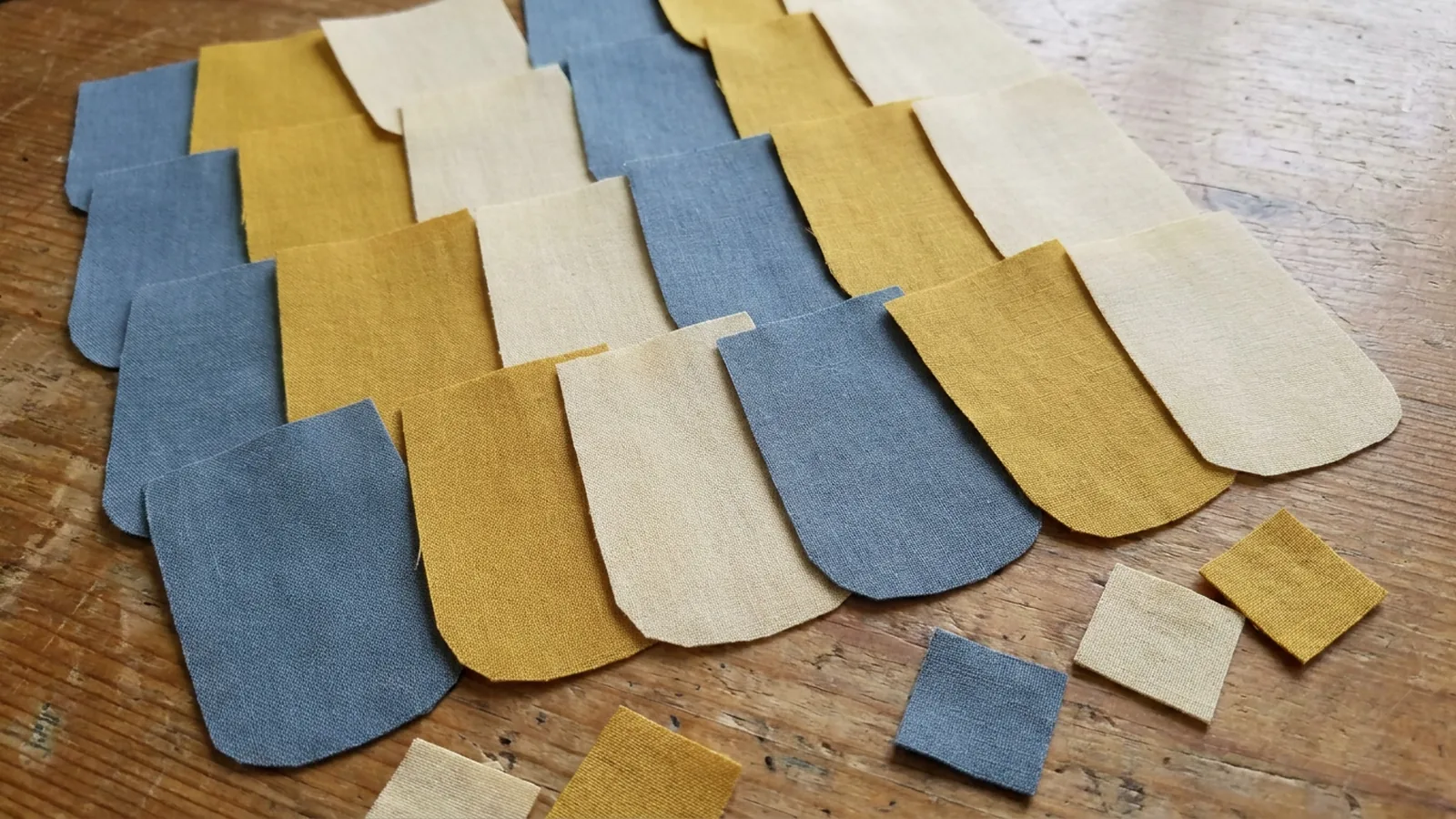
Sew the long slanted edges. Stack the squares the same way when you cut them. That same-direction note on the sheet is for the cutting stack, not for the sewn row. In the layout photo, wide ends alternate up and down within the row, and half pieces sit at the ends so the row edge is straight. The sheet does not state a measured offset between rows. The 2.5 inch figure is the raw bottom of a half piece, not a row-shift distance.
The honest limit: the top result for this search is that Quilting Board thread, and the cutting numbers live in the attached sheet, not in a size chart. Nancy Zieman does not show this one-inch charm cut. The template page does not show it either. If your charms are not five inches, this cut will not match the 3 inch top and 5 inch bottom on the sheet.
Each charm loses two top corners, one on each side. Those triangles are small. Keep them if you want a scrap border later. They are not part of the tumbler row. When you lay a row, alternate the wide end up and down, as the sheet's layout photo does, and cap both ends with the halves from one extra charm. Those halves square the row ends. They are not a measured offset.
Nancy Zieman's column layout is the same shape turned on its side, traced at 4, 6, 8, or 10 inches instead of cut from a five inch square. Pick one size for a quilt. Mixing a traced size with the charm cut in one row makes the side lengths disagree, and the row will sit unevenly.
If you would rather trace a template
Nancy Zieman traces tumblers from a template with four sizes: 4, 6, 8, and 10 inches. Trace, then cut with a ruler and rotary cutter. She notes that tumbler shapes are generally sewn in rows. Her quilt turns the shapes into columns, and groups of the same color make the open space in a modern layout. That is a design turn, not a new block. The column layout still needs the half pieces if you want straight side edges, which is the job Cut Sew Quick assigns to the half tumbler.
A template is worth it when you want several sizes in one quilt. The charm-square cut is worth it when you already have five inch squares and you want one size. Do not mix a 4 inch template tumbler and a five inch charm tumbler in the same row. The side lengths will not match.
Join the slanted edges with the seam you already use for patchwork. Cut Sew Quick builds a quarter-inch seam into its half-piece marks. Use that same seam on the charm-cut tumblers. A wider seam eats the 3 inch top, and the points miss each other. Press each slant before you join the next tumbler, so the row stays flat enough to measure.
Sew, then press the slant
Chain-piece the slanted seams. The bias is on that edge, so do not pull the pieces through the machine. Press the seam to one side, or open if the row is bulky. Then join rows. Pin the point where a wide end meets a wide end, or where a half piece meets a full one.
The 13.5 inch sample is a small finished block on that sheet, useful as a mug-rug or a test. A throw is more rows of the same tumbler. The sheet does not say how many rows make a throw. Count your charms, cut the tumblers, and add a row until the top is the length you want. Square the side of each row with the half pieces before you join rows, or the edge will stair-step.
Binding can be a straight strip. The tumbler edge is already straightened by the half pieces, so you are not binding a zigzag.
A short test row shows whether your seam matches the sheet. If the top edge waves, look at the slanted seam, not the straight bottom. Resew that row before you cut the rest of the charms.
Not this tumbler
A tumbler row is a cut square with the top corners removed. A quilt of plain squares is a different design.
See the small hours quilt, coming soon at $8.99.
Charm packs and what else they cut into are in the charm pack guide. Leftover triangles from this cut belong with the scrap quilt guide. The edge finish, once the rows are straight, is in the binding guide.
How do I cut a tumbler without a template?
Use a five inch charm square. Mark one inch in from each top corner, and cut from each mark to the bottom corner on that side. Leave the bottom corners. The top then measures 3 inches and the bottom stays 5 inches. One inset alone would leave 4 inches across the top, not 3.
How do the rows of a tumbler quilt line up?
Cut one extra tumbler down the middle. That one square makes the two end pieces for one row, so the row edge is straight. Within the row, alternate wide ends up and down. Cut Sew Quick uses half pieces to square off the rows. The sheet does not give a measured offset.
Can I use a tumbler template instead?
Yes. Nancy Zieman's template has four sizes, 4, 6, 8, and 10 inches, traced and then cut. The shapes are usually sewn in rows. Her column layout turns the tumblers sideways, which is a design choice, not a different cut.
How big is a tumbler block from charm squares?
The Quilting Board sheet's finished sample measures 13.5 inches. That is one maker's sewn sample, not a bed size. The sheet gives a sample size, not a crib or queen chart.