
Sawtooth star quilt block: cuts, flying geese, and layouts
Published 2026-10-15. Updated 2026-10-15.
A sawtooth star is a nine-patch: one center square, four flying geese for the points, and four corner squares. For a block that finishes at 12 inches, Amy Smart's cutting chart cuts a 6½-inch center, four 3½-inch corner squares, and four flying geese that finish at 3 by 6 inches. Create Whimsy uses that same 12-inch cut. The Fat Quarter Shop sheet is one unfinished 12½-inch block and has no size chart for other finished sizes.
Cut sizes for several finished blocks
Amy Smart's chart is the fast flying-geese method: one goose square and four sky squares make four geese. Finished sizes are in inches. Geese are listed unfinished, which is the size you square them to before the block is sewn.
| Finished block | Geese, unfinished | Sky squares, cut four | Goose square, cut one | Center square | Corner squares, cut four |
|---|---|---|---|---|---|
| 6 | 2 by 3½ | 2½ | 4¼ | 3½ | 2 |
| 8 | 2½ by 4½ | 3 | 5¼ | 4½ | 2½ |
| 10 | 3 by 5½ | 3½ | 6¼ | 5½ | 3 |
| 12 | 3½ by 6½ | 4 | 7¼ | 6½ | 3½ |
| 16 | 4½ by 8½ | 5 | 9¼ | 8½ | 4½ |
The 12-inch row is the one the other opened tutorials sew. Fat Quarter Shop reaches the same unfinished block, 12½ inches, with stitch-and-flip geese instead of the no-waste square: one 6½-inch center, four 3½ by 6½ rectangles, eight 3½-inch squares for the geese points, and four 3½-inch corner squares. The geese unit should measure 3½ by 6½ before the rows go together.
Days Filled With Joy sews that same 12-inch block: a 6½-inch center, four geese at 3½ by 6½, and four 3½-inch corners. The unfinished block is 12½ inches. The post dates an early printed name for the block to 1884, in Farm and Fireside.
Flying geese on their own
A flying-geese unit finishes twice as wide as it is tall. You can sew it without a star.
Connector corner. Generation Quilt Patterns cuts one rectangle for the goose and two squares for the sky. The rectangle is the finished width plus ½ inch by the finished height plus ½ inch. Each sky square is the finished height plus ½ inch. The worked example finishes at 2 by 4 inches, so the rectangle is 2½ by 4½ and the sky squares are 2½. Draw a diagonal on each sky square, sew on the side of the line away from the goose, trim the extra to a quarter inch, and press the sky open. The goose rectangle stays the size of the finished unit plus seam allowance, which is why the unit does not need a second trim if the seam is even.
No-waste squares. Create Whimsy draws a diagonal on the smaller squares, layers two of them on opposite corners of the goose square, sews a quarter-inch seam on both sides of the line, and cuts on the line into two sections. Create Whimsy then places one more marked square on each section, right sides together, sews on both sides of that diagonal, cuts on the line, and presses. Four geese come from one goose square and four sky squares. The square sizes for a sawtooth star are the sky and goose columns in the table above.
Stitch and flip on a rectangle. That is the Fat Quarter Shop method: a rectangle already cut to the unfinished geese size, and a square on each end. It wastes the trimmed triangles and keeps the long edges on the straight grain.
How the block goes together
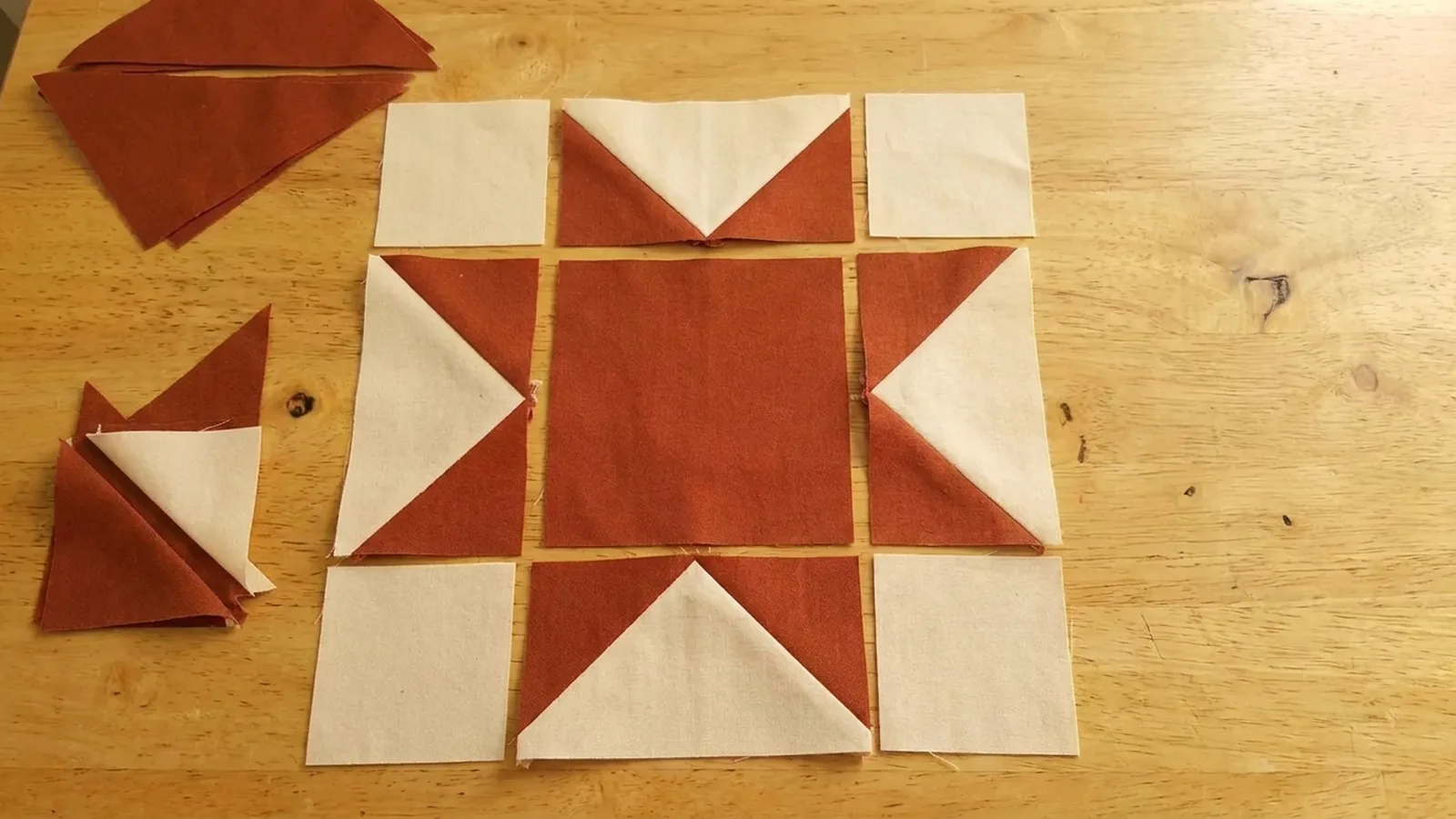
Lay the block as a nine-patch. The large goose triangle points toward the center square. The sky triangles are the star points, and they point away from the center. On the Fat Quarter Shop sheet and on Amy Smart's chart, the top goose points down, the left goose points right, the right goose points left, and the bottom goose points up. Top row: corner, goose triangle pointing down, corner. Middle row: goose triangle pointing right, center, goose triangle pointing left. Bottom row: corner, goose triangle pointing up, corner. Days Filled With Joy sews the top and bottom rows first, then the middle row, and pins through the seam that should meet the point. Create Whimsy sews the three rows and presses so the seams can nest.
Check the geese direction before you sew a row. A goose turned the wrong way is the mistake that shows after the block is done.
Layouts, not only one block
Field Guide to Quilts says flying geese are used most often as a border, and also inside blocks. The page names Kite Tails (also called Road to California in the 1897 Ladies Art Company catalog), a scrap Jacob's Ladder from 1932, and Spring Beauty. A row of geese, all pointing the same way, is a border. Rows pointing toward each other read as a zigzag. Four geese around a center, with corner squares, are the sawtooth star in the table.
Create Whimsy also names color variations of the same block: two fabrics, three fabrics, or four fabrics. The two-fabric version puts the center and the points in one fabric. The page also points to a friendship star, which uses half-square triangles instead of geese, and to an Ohio star, which uses quarter-square triangles. Those are different units. Do not cut the sawtooth chart for them.
A quilt of sawtooth stars can be set block to block, or with sashing, or with plain blocks between the stars so the points have room. Block to block makes a secondary star where four corners meet, if the corner fabric is quiet and the points are dark. Sashing keeps each star separate and adds a place for a cornerstone. Plain blocks between the stars cut the piecing in half and give the points a rest. The chart above is one block. Multiply the center, geese, and corner cuts by the number of blocks after you pick the finished block size.
Square the geese before the rows. Amy Smart's chart header says the flying-geese unit is unfinished, and that you square it up. A geese unit that is a thread long will push the center square off square, and the points will not land on the seam.
What this page will not settle
The charts assume a quarter-inch seam. A wide seam cuts the star points off. Square the geese to the unfinished size in the table before you sew the rows. This page does not choose the finished quilt size.
north point quilt offer: $8.99, coming soon.
How to make a simple star quilt block?
A sawtooth star is a nine-patch: one center square, four flying geese, and four corner squares. Sew each geese unit, join the corners to the side units, and sew the three rows.
Which simple star block uses flying geese?
The sawtooth star does. A friendship star uses half-square triangles instead. An Ohio star uses quarter-square triangles. Pick the unit you already sew.
What size to cut squares for flying geese?
For the connector-corner method, Generation Quilt Patterns cuts the geese rectangle to the finished size plus a half inch in each direction, and cuts two sky squares to the finished height plus a half inch.
What is the quick and easy way to make flying geese?
Create Whimsy sews the no-waste method through both stages: two small squares on opposite corners of a large square, a seam on both sides of the diagonal, and a cut into two sections, then one more square on each piece, sewn on both sides of its diagonal, cut, and pressed. Amy Smart's chart gives the square sizes for a sawtooth star.
What are some variations of the Flying geese quilt pattern?
Field Guide to Quilts says flying geese are used most often as a border, and also inside blocks such as Kite Tails and Jacob's Ladder. Four geese around a square make a sawtooth star.
- Fat Quarter Shop: The Ultimate Beginner Quilt, Sawtooth Star, Block Eight
- Amy Smart, Diary of a Quilter: Sawtooth Star Quilt Block Size-Cutting Chart
- Generation Quilt Patterns: Flying Geese Quilt Block - Connector Corner Method
- Create Whimsy: Free Sawtooth Star Quilt Block Pattern Tutorial
- Days Filled With Joy: How to Make a Sawtooth Star Quilt Block
- Field Guide to Quilts: Flying Geese