
How a carpenter star quilt is built
Published 2026-10-15. Updated 2026-10-15.
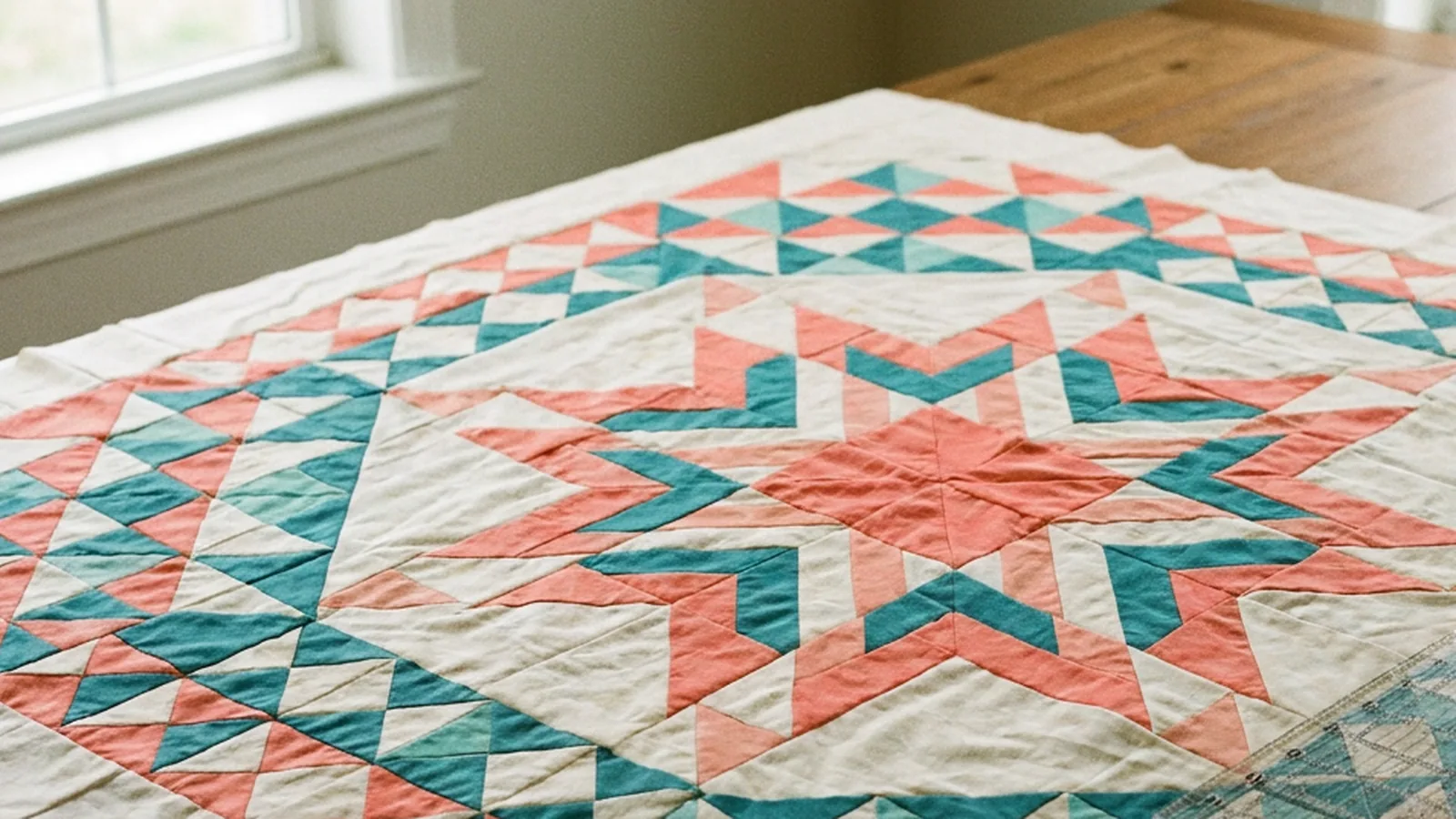
A carpenter star is one large star, not a stack of small star blocks. You build it from half-square triangles and plain squares, usually in four quadrants, then add a border. Two free instruction sets that loaded for this search finish at 66 inches square and about 56 by 68 inches. The Missouri Star PDF finishes at 83 inches square.
The units
The repeating unit is the half-square triangle. Sew Can She's free throw makes 44 of them and trims each one to 6 1/2 inches square, which is a 6 inch finished half-square triangle. The center of that quilt, before borders, is 48 inches square. She uses four fabrics: three prints and one background.
Jenny Doan's pattern starts from 10 inch squares. You sew on both sides of a marked diagonal, cut on the line, and press toward the print. That pair of squares makes two half-square triangles. The PDF calls for 32 print-and-background half-square triangles and 16 print-and-print half-square triangles. Each unit finishes at 9 inches. The center is four quadrants. Each quadrant uses four 9 1/2 inch background squares, eight print-and-background half-square triangles, and four print-and-print half-square triangles, sewn in four rows. Nine inches is the finished size of the units, not the cut of those squares.
Mary Johnson's sheet is the same idea at a smaller cut. The block size is 6 inches, which is 6.5 inches with seam allowances. You cut 16 background squares at 6.5 inches, plus 6.5 inch half-square triangles in the background and the two print fabrics. She pieces the center in four sections, then joins the sections. Fabric placement is what makes the squares read as diamonds. If the same fabric does not sit on both sides of each diamond, the star breaks.
A fourth route, from Patchwork Sampler, makes a repeating block from 2-1/2 inch strips instead of one medallion. Each block takes four print strips and two strips each of background and a contrast fabric. That is useful if your scraps are already cut to jelly-roll width. It is a different project from the one-star quilts above.
If half-square triangles are new, the half-square triangle guide covers the mark, sew, cut, and trim sequence these patterns assume.
How the star goes together
Lay the center out before you sew a single row. All three medallion patterns above depend on orientation.
Sew Can She has you arrange 44 half-square triangles, 4 dark squares, and 16 background squares in the carpenter star, then sew. Jenny's PDF has you build four quadrants, press odd rows one way and even rows the other, nest the seams, and only then sew the quadrants into two rows of two. Mary uses the same four-section center. The skill this asks for is matching points and keeping each quadrant turned the right way. It does not ask for Y-seams.
Press as the pattern says, not by habit. Jenny's PDF presses the half-square triangle seam toward the print. Patchwork Sampler presses some seams toward the background and some toward the print, depending on which pair you just sewed. Mixing those directions in one quilt makes the points bulky on one side and hollow on the other.
Borders and the finished size
The star size is the center plus the borders you add. Do not assume one finished measurement.
Sew Can She's throw finishes at 66 inches square. After the 48 inch center she adds three borders. The first and the outer border are cut from 3 1/2 inch strips. She expects the outer side borders to land near 60 1/2 inches and the top and bottom near 66 1/2 inches, and she tells you to measure the quilt top and cut to that measurement rather than trust the expected length. To finish the quilt she lists 4 yards of backing, or enough to piece a 72 inch square back, plus batting at least 72 inches square and 1/2 yard of binding.
Jenny's quilt finishes at 83 inches square. The border is cut from eight 6 inch strips sewn end to end. The PDF says the side strips are about 72 1/2 inches and the top and bottom about 83 1/2 inches, and the construction notes say to measure the quilt in three places and use the average. Background for the top is just over 2 yards, or a package of 10 inch background squares, plus a separate 1 1/2 yard border cut and 3/4 yard of binding. Those yardages belong to that pattern. They will not cover Sew Can She's throw or Mary's rectangle.
Mary's quilt is about 56 by 68 inches. After the center she pieces 28 border rectangles. The border block is 6 by 4 inches finished, which is 6.5 by 4.5 inches with seam allowances. She cuts 14 rectangles of each print at 7 and 1/8 by 4 and 3/4 inches, cuts them on the diagonal, and sews one half to the other. Rectangles have a direction. She says to cut them in pairs, wrong sides together, so you get both the regular half and the reversed half. Squares can be rotated. These cannot.
What to cut first
Pick one pattern and cut only for that one.
| Pattern | Center units | Finished quilt |
|---|---|---|
| Sew Can She throw | 6 inch finished half-square triangles, 44 of them | 66 inches square |
| Jenny Doan PDF | 9 inch finished units from 10 inch squares | 83 inches square |
| Mary Johnson sheet | 6.5 inch cut squares and half-square triangles | about 56 by 68 inches |
| Patchwork Sampler block | half-square triangles from 2-1/2 inch strips | one block, not a set quilt size |
A 1/4 inch seam is the allowance in both the Sew Can She throw and the Jenny Doan PDF. If your seam is wider, the quadrants will not meet and the border lengths in the table will be short.
Free patterns, and one that is not this design
The free files this guide opened are Sew Can She's throw, written out on the page, and Mary Johnson's instruction sheet. Jenny's PDF is the source for the 83 inch size and the 10 inch square method. It is Missouri Star's pattern, copyright 2020, and the file itself says it is not for reprinting. Use it as the pattern you follow, not as a file to copy onto another site.
See the north point quilt, coming soon at $8.99.
That offer is a different design. It is not a carpenter star, and this page does not sell the free patterns linked above.
One limit of this advice: the three medallion sizes do not scale by a single percentage. Changing the half-square triangle from 6 inches finished to 9 inches finished changes the center, the border math, and the yardage. Follow one pattern's cuts all the way through.
Is there a free Carpenter's Star quilt pattern available?
Yes. Sew Can She publishes a free throw on the page, finished at 66 inches square, and Mary Johnson publishes a free instruction sheet for a quilt of about 56 by 68 inches. Both are linked below.
How is a carpenter star quilt built?
One large star, pieced from half-square triangles and plain squares, usually in four quadrants so the points meet in the middle. Borders are added after the center is sewn.
What units does a carpenter star use?
Half-square triangles are the main unit. Some versions also use plain squares in the center and half-rectangle units in a pieced border.
What size does the star finish?
It depends on the pattern. The free throw opened here finishes at 66 inches square. The Missouri Star PDF finishes at 83 inches square. Mary Johnson's sheet is about 56 by 68 inches.