
How to make a potato chip quilt block from scraps
Published 2026-10-15. Updated 2026-10-15.
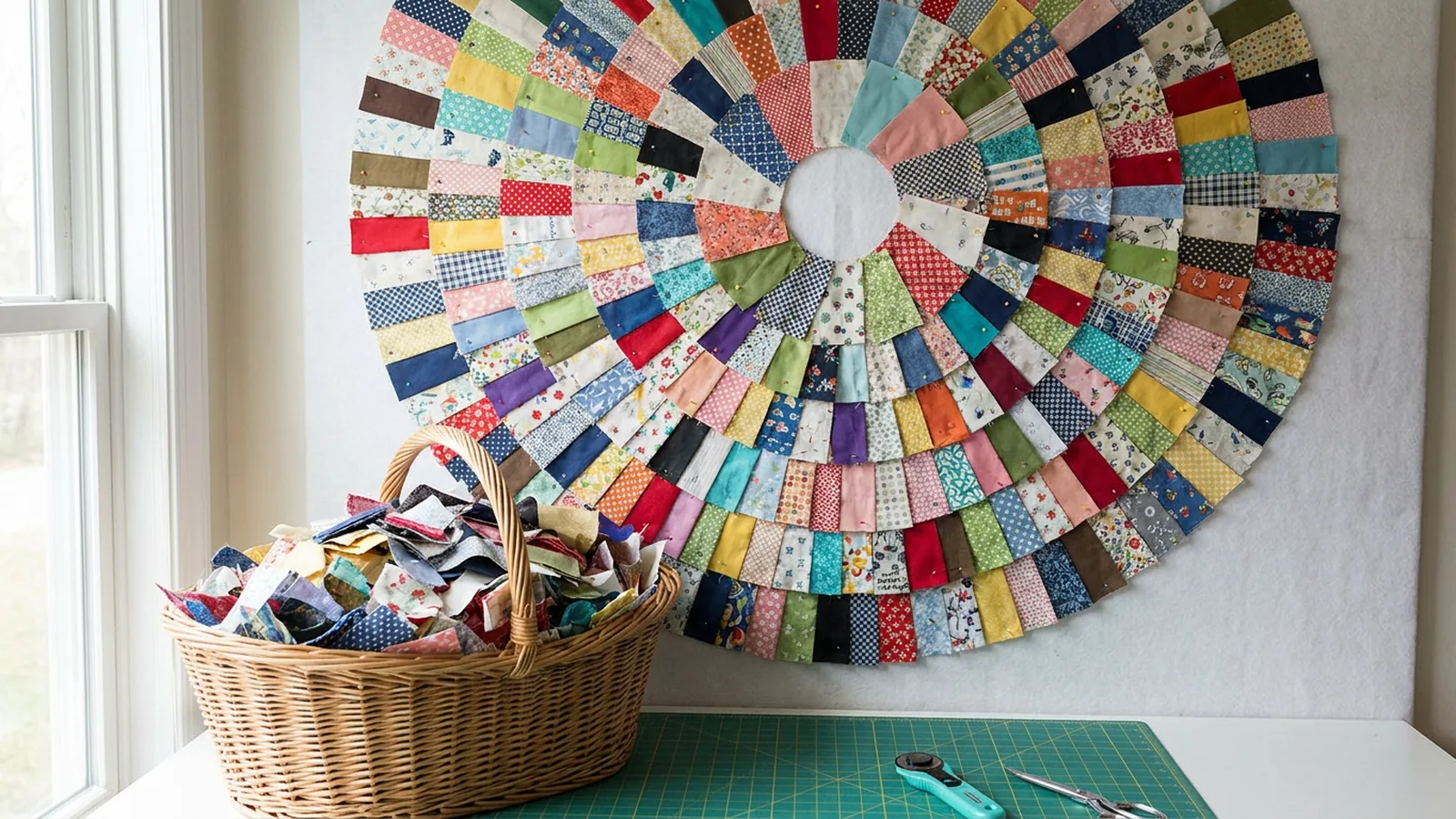
A potato chip quilt block is a scrap block made from one rectangle size, sewn in rounds around a center pair. The written account that gives cut sizes uses 2.5 inch by 4.5 inch rectangles, cut from 2.5 inch strips. A basic block has a center pair, a middle round, and an outer round. The post puts 12 rectangles of color in the inner and outer rounds together, and 6 in the middle round, 18 rectangles in all. That twelve is shared by the inner and outer rounds. It is not 12 in each round, and the center pair is already inside it. Twenty of those blocks, set 4 by 5, finished at 48 inches by 60 inches.
What the block is
The name shows up on scrap quilts that eat a strip bin. The Lettuce Craft post describes a block with a center pair, a middle round, and an outer round. You can alternate color or value from round to round: light in the center and dark on the outside, one color per block, or bands of light and dark. Two different versions, turned against each other, make the quilt move. The post compares adding rounds to a granny square. A larger block is the same rectangle with more rounds, not a new cut.
That is the construction route the opened pages support. Lay the rectangles in rounds before you sew, so the value change matches the photo you are following. The post built every center first, then every middle round, then every outer round, instead of finishing one block at a time. That assembly line is how a scrappy set stays even. The maker sorted rainbow scraps into 12 shades and pulled a different fabric for each rectangle in a round, so no two neighbors were the same print.
The Sarnia Quilters Guild booklet is the other opened file. It is dated 2024 and titled for dark and light scraps that make secondary patterns. Its pages are layout diagrams rather than a cutting chart. Some say to rotate each block 90 degrees. Others say to alternate two blocks. That is the second half of the design: the block is simple, and the quilt appears when the blocks turn or trade places.
If you already piece scrap blocks, the scrap quilt guide is the wider set of ways to use a strip bin. A potato chip block is one of those ways, not a traditional named block like a nine-patch.
Cut size and block size
Use one rectangle for the whole quilt. In the Lettuce Craft quilt that rectangle is 2.5 inches by 4.5 inches, from 2.5 inch strips. Those strips are a common scrap width. If your bin is already cut to that width, you are cutting length only.
| Round plan | Rectangles | What the captured account reports |
|---|---|---|
| Center pair | a pair | The inner part of the combined twelve |
| Middle round | 6 | The contrasting round the post counts |
| Outer round | ten | The rest of that twelve, on the booklet page 2 diagram |
| Inner and outer together | 12 | One combined count, not 12 in each round |
| Three-round total | 18 | 12 plus the middle 6 |
| Five rounds | more of the same rectangle | A 20 inch block in that quilt |
| Twenty blocks, 4 by 5 | the three-round block | A top of 48 by 60 inches |
The 20 inch block and the 48 by 60 inch top are that one quilt, not a rule for every potato chip. The post says you pick the block size by adding rounds, and that five rounds of these rectangles made a 20 inch block used as a pillow. If you want a different finished block, add or stop a round and measure the block you just sewed. Do not scale the 2.5 by 4.5 inch cut in your head and assume the 48 by 60 inch top still holds.
A three-round block in that account is the combined 12 plus the middle 6, which is 18 rectangles. The center pair sits inside the 12. That twelve is shared by the inner and outer rounds, so it is not 12 in each. The Sarnia Quilters Guild booklet page 2 diagram shows the split: a center pair, six middle rectangles, and ten outer rectangles. A seam-by-seam sewing order is outside the written post.
How the scrappy layout comes together
Three decisions make the quilt, and all three are in the opened files.
First, alternate value by round. A block that is dark, light, dark reads as a ring. A block that is light, dark, light reads as the opposite ring. The Lettuce Craft quilt made both, in bright scraps against black, and alternated them.
Second, turn the blocks. The guild booklet's instruction on several pages is to rotate each block 90 degrees. Other pages alternate two blocks. Rotation is what turns a stack of similar blocks into a secondary pattern. If every block faces the same way, you get stripes of rounds. If you rotate, the rounds step around the quilt.
Third, sew in rounds across the whole set. The post laid the blocks out, stacked the pieces, and worked from the pile. That keeps the color distribution even. Sewing one finished block before you cut the next makes it easy to drift toward one favorite fabric.
Binding in that quilt was a separate scrap decision: black and white stripes, and the shop minimum meant the maker ordered 2 yards. That 2 yard figure is a shop minimum for that order, not a binding formula. Measure your own perimeter when you bind.
What this page cannot take from the search results
Pinterest, a Missouri Star forum thread, and a YouTube playlist sat at the top of the bought results. Those three captures came back as a challenge page or as a page with no article text, so they are not the source of the cuts above. The cut sizes come from the Lettuce Craft post, and the layout idea comes from the guild booklet. A video can show a folded-strip method. That method is outside the two files this guide could read. Follow the round method in those files, or treat a video as its own set of steps.
A different block, if you want a simple cross instead
Our plain cross block: $4.00, coming soon.
That offer is not a potato chip block. The rectangle rounds above are the scrap method, and they do not require a pattern purchase.
One limit of this advice: the 48 by 60 inch size and the 20 inch five-round block belong to one maker's rectangles and seam allowance. A wider seam than the one you usually sew changes the finished block. Measure the first block before you cut all 20.
What is a potato chip quilt?
A scrap quilt made from one rectangle size, built in rounds around a center pair, then set so the blocks form a secondary pattern. The written layout opened here uses 2.5 by 4.5 inch rectangles.
What size block should I use for a potato chip quilt?
Start with three rounds. That is the basic block in the Lettuce Craft account. Five rounds of the same rectangles made a 20 inch block in that quilt. Adding a round is how that maker changed the size.
How many rectangles does a three-round block use?
The post puts 12 rectangles in the inner and outer rounds together, and 6 in the middle, 18 in all. The guild booklet page 2 diagram shows that twelve as a center pair plus ten outer rectangles, with six in the middle.